Experimental stations with 2×1 and 2×2 callsigns
Original: Ryota / JJ1WTL — 496631611 · Original Japanese HTML
Published: 2023-01-11
English translation of the archived article text. The author’s first-person observations, uncertainty and later additions are preserved; this is not the research summary. Image contents are preserved as images, not silently incorporated into the translated prose.
We are not alone. Amateur and experimental test stations share the same callsign format: https://www.itu.int/en/ITU-R/terrestrial/fmd/Documents/fxm-callsignformation.pdf.
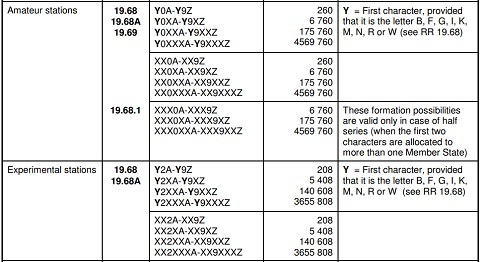
That is also why JB was formerly not assigned to amateurs, according to the Principles of Frequency Allocation:

I collected the callsigns of experimental test stations that have them and disclose them.
Search results
The links in the table below lead to Radio Station Information Search. For experimental test stations, searching by callsign is not possible. I find them by searching everything. After the late-night update on Tuesday, January 10, I searched 7,565 records.
| Callsign | Licensee | QTH | Emission, frequency and power |
|---|---|---|---|
| JG2XA | University of Electro-Communications | Chofu City, Tokyo | 1K50H2A: 5006, 8006 kHz, 200 W; N0N: 5006, 8006 kHz, 200 W |
| JG7XB | Saga Prefecture | Saga City, Saga Prefecture | 3K00J3E: 13510 kHz, 50 W; 60M0P0N: 9410 MHz, 25 kW |
| JG8XA | National Institute of Technology | Aoba Ward, Sendai City, Miyagi Prefecture | 57M0P0N: 9410 MHz, 25 kW |
| JN2L | Geosports | Sammu City, Chiba Prefecture | 16K0G1D: 48.425 MHz, 300 W |
| JN2M | Geosports | Pacific Ocean and Sea of Japan, excluding waters at or south of 30°N and at or west of 135°E | 16K0G1D: 48.425 MHz, 100 W |
| JN2N | Geosports | Pacific Ocean and Sea of Japan, excluding waters at or south of 30°N and at or west of 135°E | 16K0G1D: 48.425 MHz, 100 W |
| JN2S | Geosports | Pacific Ocean and Sea of Japan, excluding waters at or south of 30°N and at or west of 135°E | 16K0G1D: 48.425 MHz, 100 W |
| JN2T | Geosports | Pacific and Sea of Japan coastal regions, excluding areas at or south of 30°N and at or west of 135°E | 16K0G1D: 48.425 MHz, 200 W |
| JS2IR | Geosports | Joso City, Ibaraki Prefecture | 16K0G1D: 43.65 MHz, 250 W |
| JS2IS | Geosports | Nationwide | 16K0G1D: 43.65 MHz, 100 W |
| JS2IT | Geosports | Nationwide | 16K0G1D: 43.65 MHz, 100 W |
| JS2IZ | Geosports | Nationwide | 16K0G1D: 43.65 MHz, 100 W |
| JS2JA | Geosports | Nationwide | 16K0G1D: 43.65 MHz, 100 W |
| JS2JB | Geosports | Nationwide | 16K0G1D: 43.65 MHz, 100 W |
| JS2RA | DATACOM SERVICES | Sodegaura City, Chiba Prefecture | 12K0D1D, 12K0G1D: 6864, 6900, 9081, 9126, 10845, 10953, 12117, 12159, 14673, 14736, 16119, 16209 kHz, 10 kW |
| JS2RB | [Added March 26] DATACOM SERVICES | Sodegaura City, Chiba Prefecture | 12K0D1D, 12K0G1D: 6864, 9081, 10845, 12117, 14673, 16119 kHz, 5 kW |
| JS2SJ | Geosports | Nationwide | 16K0G1D: 43.65 MHz, 100 W |
| JS2SK | Geosports | Nationwide | 16K0G1D: 43.65 MHz, 100 W |
| JS2SL | Geosports | Nationwide | 16K0G1D: 43.65 MHz, 100 W |
| JS2WY | Nihon University | Asahigaoka, Nerima Ward, Tokyo, and surroundings; Nakatomi-Minami, Tokorozawa City, Saitama Prefecture, and surroundings; Kagana, Tateyama City, Chiba Prefecture, and surroundings | 17M5X7W: 10.48 GHz, 100 mW; 15M5G7W and 15M5D7W: 10.48 GHz, 200 mW |
| ***** JS2ZB | Ministry of Internal Affairs and Communications | Nagano City, Nagano Prefecture | 200KF3E, 200KF8E: 139 frequencies at 100 kHz intervals from 76.1 to 89.9 MHz, 100 W |
Notes
Area numbers Experimental test stations cannot use 0 or 1; see the Radio Regulations table at the start. Consequently, their numbers differ from amateur numbers: Kanto is 2, …, Hokkaido is 9. Do not worry: Shinetsu shares 2 with Kanto, and Hokuriku shares 3 with Tokai.
JG2XA When the HF JJY service ceased, the university with JA1ZGP established this independently for HF Doppler observations: ‘JG2XA returns’. https://www.7l4iou.com/2022/02/jg2xa.html
JG8XA Sendai College's Hirose campus: ‘No. 33: the Hirose Amateur Radio Club, JA7YCQ, at National Institute of Technology, Sendai College’. https://www.fbnews.jp/201811/musennosekai/index2.html
JS2ZB Probably the Shinetsu Bureau of Telecommunications' FM equipment for temporary emergency broadcasts: ‘Deployment of FM equipment for temporary emergency broadcasting’. https://www.soumu.go.jp/soutsu/shinetsu/sbt/hodo/140422-2.html
30°N Passes through Kuchinoshima, Toshima Village, Kagoshima Prefecture.
135°N [sic; 135°E] Passes through Akashi City. There was recently even an 8J3135E.
Experimental stations for ocean HF radar
These were disclosed too, so I include them. When they graduate from the experimental stage, they become radiolocation land stations. OR presumably comes from ‘Ocean Radar’ [spelled ‘Rader’ in the source].
| Callsign | Licensee | Location | Emission, frequency and power |
|---|---|---|---|
| JOR8100 | University of the Ryukyus | Nishi Ward, Niigata City, Niigata Prefecture | 500HA1A: 24515 kHz, 50 W; 20K0Q0N: 24515 kHz, 50 W |
| JOR8150 | Ministry of Land, Infrastructure, Transport and Tourism | Omaezaki City, Shizuoka Prefecture | 100KQ3N: 13500 kHz, 80 W; 500HA1A: 13500 kHz, 80 W |
| JOR8502 | Mitsubishi Electric | Muroto City, Kochi Prefecture | 500HA1A: 24515 kHz, 80 W; 105KF3N: 24515 kHz, 80 W |
Aviation-related experimental stations
These are not callsigns, but I include them while I am at it. Is Iwanuma the Civil Aviation College?
| Identification | Licensee | Location | Emission, frequency and power |
|---|---|---|---|
| EIW | Ministry of Land, Infrastructure, Transport and Tourism | Iwanuma City, Miyagi Prefecture | 21K0AXX: 112.4 MHz, 100 W; 700KVXX: 1158 MHz, 1 kW |
| EKD | Ministry of Land, Infrastructure, Transport and Tourism | Iwanuma City, Miyagi Prefecture | 2K50A2X: 109.904 MHz, 10 W; 2K50A2X: 109.896 MHz, 10 W |
| EKD | Ministry of Land, Infrastructure, Transport and Tourism | Iwanuma City, Miyagi Prefecture | 700KVXX: 997 MHz, 100 W |
| ENIG | National Institute of Maritime, Port and Aviation Technology | Ishigaki City, Okinawa Prefecture | 16K8G1D: 114.05 MHz, 80 W |
The debate over vanity and qualification-based callsigns
View 1
As shown, 2×1 and 2×2 callsigns are allocated to experimental test stations, so amateurs cannot use them freely.
View 2
That said… As noted above, very few stations receive callsigns these days. Most probably use spoken identification names, such as ‘JARL Experiment 10’. So there is plenty of space. One option might be to confine experimental stations to the JS series.
View 3
The following two issues are often conflated in discussion. They are separate matters, each with its own obstacles:
- Introducing vanity or qualification-based callsigns.
- JARL getting involved and making money from them.
On top of that, there is a misconception that ARRL makes money from vanity callsigns. It does not. The application fee was passed through entirely to the FCC. Later, the FCC gave up on burdens such as processing refunds when it could not grant the requested callsign, and made it free. Subsequently, charges have returned; payment now goes directly to the FCC.
The ITU’s compilation
A country-by-country survey asking, in effect, ‘How do amateur and experimental callsigns differ in your country?’ ‘Operational Bulletin No. 867 (1.IX.2006) and List annexed: Status of Radiocommunications between Amateur Stations of different Countries (In accordance with optional provision No. 25.1 of the Radio Regulations) and Form of Call Signs assigned by each Administration to its Amateur and Experimental Stations (Position on 1 September 2006)’. https://www.itu.int/pub/T-SP-OB.867-2006 Direct link: ‘ITU Operational Bulletin No. 867, 1.IX.2006’. https://www.itu.int/dms_pub/itu-t/opb/sp/T-SP-OB.867-2006-OAS-R1-PDF-E.pdf Japan says:
Amateur stations: JAnAA-JAnZZ (n = 0-9); JR6AA-JR6NZ; JRnVA-JRnWZ (n = 0-9); JR6YA-JR6YZ; JxnAAA-JxnQQZ (x = A, E-S) (n = 0-9); JxnQUA-JxnZZZ (x = A, E-S) (n = 0-9); JD1AAA-JD1QQZ; JD1QUA-JD1ZZZ; 7JnAAA-7JnBZZ (n = 0, 4, 5, 7-9); 7JnAAA-7JnCZZ (n = 2, 3, 6); 7J1AAA-7J1DZZ; 7JnYAA-7JnYMZ (n = 0-5, 7-9); 7J6YAA-7J6YQZ; 7xnAAA-7xnQQZ (x = K-N) (n = 1-4); 7xnQUA-7xnZZZ (x = K-N) (n = 1-4); 8xnAAA-8xnQZZ (x = J, N) (n = 0-9); 8xnQUA-8xnZZZ (x = J, N) (n = 0-9) Experimental stations: JxnA-JxnZ (x = B, G, J, O, S) (n = 2-9); JxnAA-JxnZZ (x = B, G, J, O, S) (n = 2-9)
How it was made
Step 1: summary search
First, sweep through every experimental test station. Use Expert Search, not the API, to collect and save the regional telecommunications-bureau codes and DFCD identifiers.
[Translator’s note: the code is preserved as displayed in the archived HTML, including its original literals and apparent encoding artefacts. In its comments and matched text, 送信 means “send”, 検索結果件数 means “number of search results”, and 株式会社ALE is “ALE Co., Ltd.”.]
#!/usr/bin/perl -w

open (OUTFILE, ">jikken\.csv")  || die "cannot write\n";

use LWP::UserAgent;
use HTTP::Request::Common;

$page = 1;
$pagemax = 1;

while ($page <= $pagemax) {
  $start = 1 + 500*($page - 1);
  $request = GET('https://www.tele.soumu.go.jp/musen/SearchServlet?SC='.$start.'&pageID=3&SelectID=5&CONFIRM=0&OW=EX+0&SK=2&DC=500');


  # 送信
  $ua = LWP::UserAgent -> new;
  $res = $ua -> request( $request ) -> as_string;

  @yoso = split /\n/,$res;
  $gyo = split /\n/,$res;
  print "gyo - ".$gyo."\n";

# 413- 				<B>検索結果件数</B>  1 ~ 500 / 7402


  if ($pagemax == 1) {
    $j = 350;
    while ($j <= 550) {
      $_ =  $yoso[$j];
      chomp;
      chomp;
      if (/検索結果件数/) {
        $total = substr $_, ((rindex $_, "/") + 1);
        $total =~ s/ //gs;
        $pagemax = int ($total/500) +1;
        print "TOTAL|".$total."|$pagemax"."|\n";
      }
      $j++;
    }
  }

  $j = 350;
  while ($j < $gyo) {
    $_ = $yoso[$j];
    if (/pageID=4/) {
       @licensee = split /\&/,$yoso[$j];
       $sotsu = substr ($licensee[1],3,1);
       $dfcd = substr ($licensee[2],5,10);
       $qra = substr ($licensee[4],0);
       $qra =~ s/styleNumber\=\d\d\" target\=\"_blank\"\>//;
       $qra =~ s/\<\/a\>//;
       $display = $sotsu."\,".$dfcd."\,".$qra."\,\n";
       print $display;
       print OUTFILE $display;
    }
    $j++;
  }
  $page++;
}

# 473-		<a href="./SearchServlet?pageID=4&IT=A&DFCD=0004159068ⅅ=1&styleNumber=21" target="_blank">株式会社ALE</a>

close OUTFILE;
exit;
Step 2: detailed search
Using the bureau codes and DFCD identifiers saved in Step 1, query each record in turn and collect its identification signal. Searching 7,565 records took about thirty minutes.
[Translator’s note: in the code, 識別信号 means “identification signal”; the Japanese literal must remain unchanged for the source-page match. 送信 means “send”.]
#!/usr/bin/perl -w

open (OPENFILE,"jikken.csv") || die "No such file \n";
open (RESULT, ">jikken-call.csv")  || die "cannot write gyo\n";
use LWP::UserAgent;
use HTTP::Request::Common;

$i = 1;
while (<OPENFILE>) {
  s/\n//gs;
  s/\r//gs;
  ($sotsu, $dfcd, $qra) = split (/\,/,$_);

# https://www.tele.soumu.go.jp/musen/SearchServlet?pageID=4&IT=A&DFCD=0004159068ⅅ=1&styleNumber=21

  $request = GET('https://www.tele.soumu.go.jp/musen/SearchServlet?pageID=4&IT='.$sotsu.'&DFCD='.$dfcd.'ⅅ=1&styleNumber=21');

  # 送信
  $ua = LWP::UserAgent -> new;
  $res = $ua -> request( $request ) -> as_string;

  @yoso = split /\n/,$res;
  $gyo = split /\n/,$res;

#161		<td id="deftd">識別信号</td>
#
#163		<td id="deftd" colspan="3">
#
#165				*****       <BR>

  $j = 1;
  $call = "";
  while ($j < $gyo) {
    if ( $yoso[$j] =~ /識別信号/) {
      $call = $yoso[$j+4];
      $call =~ s/\t//gs;
      $call =~ s/\s//gs;
      $call =~ s/\<br\>//gs;
      $call =~ s/\<BR\>//gs;
      last;
    }
    $j++;
  }
  print $i."-".$sotsu."\,".$dfcd."\,".$call."\,".$qra."\,\n";
  print RESULT $sotsu."\,".$dfcd."\,".$call."\,".$qra."\,\n";
  $i++;
}
close OPENFILE;
close RESULT;
exit;