JS2RA / JS2RB
Original: Ryota / JJ1WTL — 499204144 · Original Japanese HTML
Published: 2023-05-02T01:45:00+09:00
English translation of the archived article text. The author’s first-person observations, uncertainty and later additions are preserved; this is not the research summary. Image contents are preserved as images, not silently incorporated into the translated prose.
These are experimental stations for HF digital fixed services.
The intended application is financial trading.
I have identified their QTH [location].
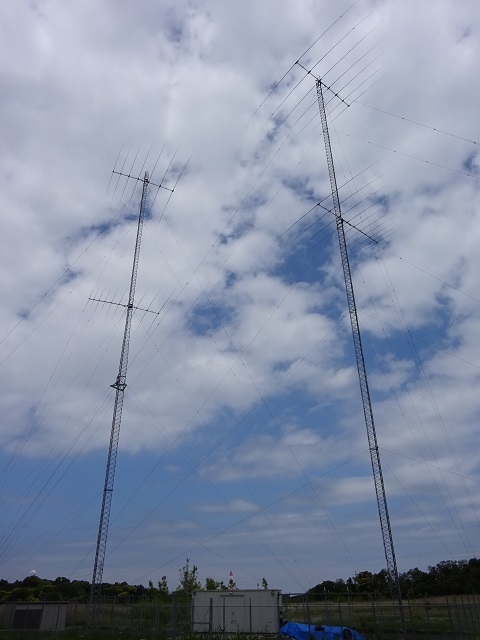
In the Kubota cadastral area of Sodegaura City.
South of Chiba Prefectural Route 300, Shiinomori-dori.
Immediately west of Nikken Lease Kogyo Plant's Sodegaura factory.
Google Maps satellite imagery shows only the foundations, with construction in full swing:
https://www.google.co.jp/maps/@35.446535,140.019756,40m/data=!3m1!1e3
-
Centre: station building.
-
Left/west: Philippines-bound tower, JS2RB.
-
Right/east: US/Chicago-bound tower, JS2RA.
-
Two more points farther left/west: guy anchors.
Street View shows the towers after erection:
The antennas are probably:
-
Right: toward the USA/Chicago.
-
Left: toward the Philippines.
-
Upper: 6–10 MHz.
-
Lower: 9–30 MHz.
The basis for that interpretation is explained below.
A long account follows; read on if interested. TNX TO JQ1XLC ES JO3NEA FER UR INFO.
Disclosure in the Radio Station Information Search
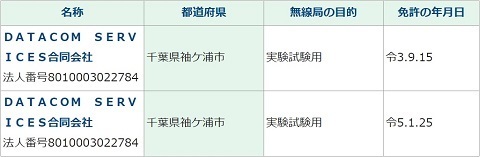
From this, we can identify Sodegaura City, at least.
The upper station is JS2RA:
https://www.tele.soumu.go.jp/musen/SearchServlet?pageID=4&IT=A&DFCD=0004295380&DD=1&styleNumber=21
The lower station is JS2RB:
https://www.tele.soumu.go.jp/musen/SearchServlet?pageID=4&IT=A&DFCD=0004448132&DD=1&styleNumber=21
Those are the two.
I excerpt and compare them below.
Advocates of vanity callsigns and licence-class-specific callsigns should pause for a moment.
As you can see, experimental stations occupy part of the callsign space.
JS2RA
Licensee: DATACOM SERVICES GK. Licensee address: *****. Station category: experimental station. Licence number: *****. Licence issued: September 15, 2021. Valid until December 31, 2023. Purpose: experiments and tests. Permitted operating hours: continuous. Communications: matters relating to experiments, tests or investigations, excluding Argos-system data transmission and education. Correspondent: receiving equipment belonging to the licensee near Chicago, USA. Identification signal: JS2RA. Installation location or operating area: Sodegaura City, Chiba Prefecture. Emission classes: 12K0D1D, 12K0G1D. Frequencies: 6864, 6900, 9081, 9126, 10845, 10953, 12117, 12159, 14673, 14736, 16119, 16209 kHz. Antenna power: 10 kW. Remarks: blank.
JS2RB
Licensee: DATACOM SERVICES GK. Licensee address: *****. Station category: experimental station. Licence number: *****. Licence issued: January 25, 2023. Valid until December 31, 2023. Purpose: experiments and tests. Permitted operating hours: continuous. Communications: matters relating to experiments, tests or investigations, excluding Argos-system data transmission and education. Correspondent: receiving equipment belonging to the licensee in an outlying area of the Philippines. Identification signal: JS2RB. Installation location or operating area: Sodegaura City, Chiba Prefecture. Emission classes: 12K0D1D, 12K0G1D. Frequencies: 6864, 9081, 10845, 12117, 14673, 16119 kHz. Antenna power: 5 kW. Remarks: blank.
Comparing the two stations
The Philippines link is exactly half the scale of the US link.
| Field | To USA | To Philippines |
|---|---|---|
| Licence issued | 2021-09-15 | 2023-01-25 |
| Identification signal | JS2RA | JS2RB |
| 6864 kHz | ✓ | ✓ |
| 6900 kHz | ✓ | |
| 9081 kHz | ✓ | ✓ |
| 9126 kHz | ✓ | |
| 10845 kHz | ✓ | ✓ |
| 10953 kHz | ✓ | |
| 12117 kHz | ✓ | ✓ |
| 12159 kHz | ✓ | |
| 14673 kHz | ✓ | ✓ |
| 14736 kHz | ✓ | |
| 16119 kHz | ✓ | ✓ |
| 16209 kHz | ✓ | |
| Antenna power (kW) | 10 | 5 |
The background: money makes the world go round
The idea is: ‘How can we hit Return sooner than the competition?’ In reality, the trading is automated.
First, an overview of the surrounding developments.
Illustration: this figure alone can be clicked to enlarge.
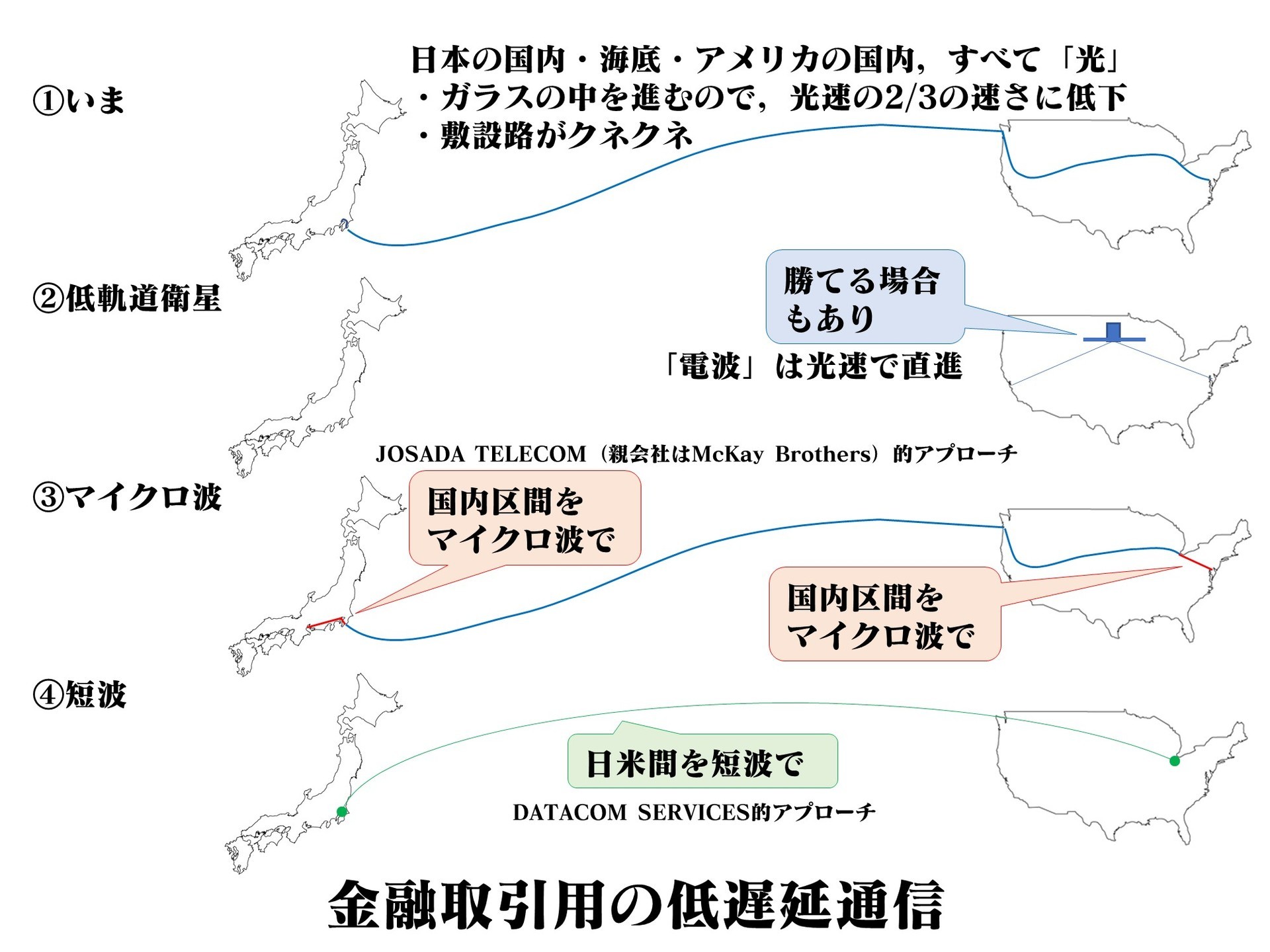
(1) The present arrangement
Data centres are linked by optical communications.
But:
Light progresses slowly, reflecting as it travels through glass, a denser medium than free space.
Its speed falls to two-thirds of the original—or, according to some sources, a reduction of thirty to forty percent.
What ought to be 300,000 km/s is held down to 200,000 km/s.
Of course, the intervening routers and switches also convert it to electrical form internally before relaying it: optical–electrical–optical.
Low-latency equipment is prized in financial trading.
Arista, a later entrant doing well, is an example.
(2) Using low-Earth-orbit satellites
As you know, geostationary orbit means hopeless latency.
But low-Earth-orbit satellites have a chance against fibre.
Example article:
『LEO Speed: When Milliseconds are Worth $Millions… An NSR Insight』
https://news.satnews.com/2020/10/14/leo-speed-when-milliseconds-are-worth-millions-an-nsr-insight/
The article above presents a simulation of a multi-hop New York–London connection.
(3) Using microwaves
This does not cross the Pacific; it applies only to the domestic sections at each end.
Rather than a slow fibre route that also takes a detour, the idea is to connect directly by microwave—bang!
A digression from this article's subject: the JOSADA TELECOM system I am investigating separately appears to reach Toyosu's data centres from the Chikura cable landing station in two or three hops.
It crosses both Tokyo Bay and Ise Bay, something the fibre route cannot do [annotations on a GSI map].
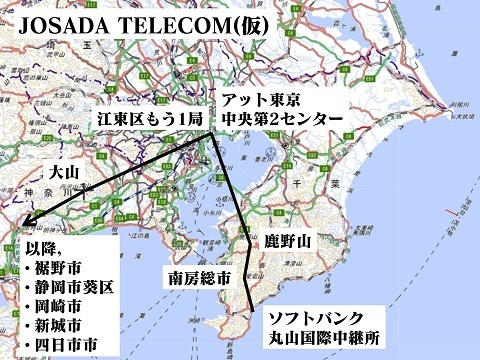
JOSADA TELECOM in the Radio Station Information Search:
The parent company's website describes the service:
https://www.mckay-brothers.com/
(4) Using HF
This is what I wanted to get to.
There is not much transmission capacity—the direction is toward 12 kHz bandwidth—but low latency can be expected.
MIC discussion material (https://www.soumu.go.jp/main_content/000862404.pdf) says there is a 17 ms advantage over optical fibre.
Who would have imagined the HF era returning?
Milestones in Japan–US HF links:
-
1916, Taisho 5: Funabashi–Hawaii.
-
1956, Showa 31: telex service.
To the site
Preliminary research
‘Analysis of measured HF digital fixed-station data and VOACAP’:
https://www.soumu.go.jp/main_content/000862434.pdf
contains this clue:
The experimental station transmits from a 59 m tower at an antenna power of 10 kW, using two antennas, on a bearing of 33.9°. The antennas are:
A log-periodic antenna for the 6–10 MHz band.
A log-periodic antenna for the 9–30 MHz band.
A Google search for ‘Sodegaura log-periodic’ promptly found a tweet from JQ1XLC:
https://twitter.com/JQ1XLC/status/1647957507787091970
On the road from the Tateyama Expressway's Anesaki-Sodegaura interchange toward the Kitasode interchange on Route 16, two huge towers had been built on the left. They carried what looked like HF log-periodics and an HF Yagi. What were those…?
…That's it.
I searched Google Maps satellite imagery along that road, on the left, but found nothing.
There was, however, a suspicious spot.
As it turned out later, it was exactly right: the foundations under construction mentioned above.
It was actually visible in Street View; I hadn't noticed…
‘Don't use machines! Use your eyes!’—episode 20, the celebrated ‘Escape from the Scorching Heat’—so off to investigate on site.
A 59 m tower ought to be findable.
To Nagaura
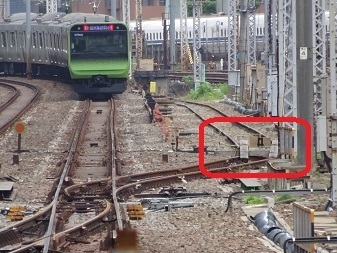
Tamachi. The siding toward Hamamatsucho is already closed. They will remove it, shift three tracks from right/east to left/west, and bring the Haneda Airport Line out between the inbound and outbound Tokaido Main Line tracks.
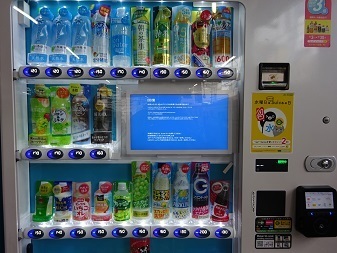
Shimbashi. A vending-machine error.
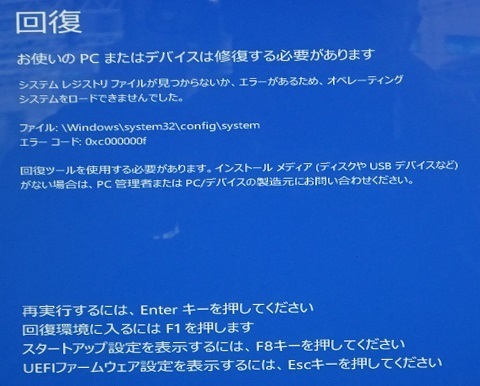
Windows, of course.
Onto the Sobu Rapid Line, departing 8:00.
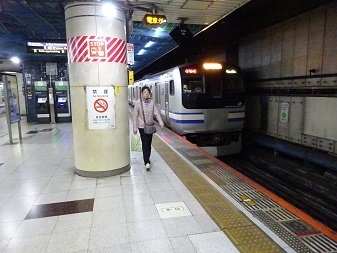
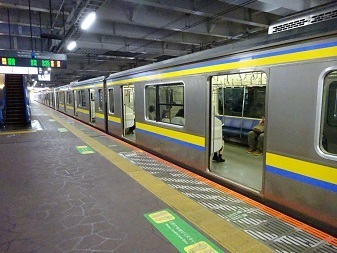
What? Terminates at Tsudanuma. The world is on the weekday timetable, orz. Stitching the journey together: onto the 8:39 for Narita Airport.
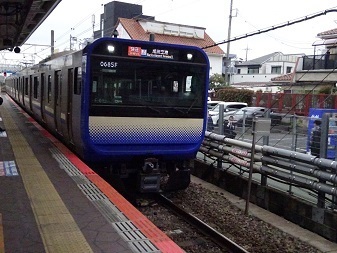
Chiba. Departure 8:44.
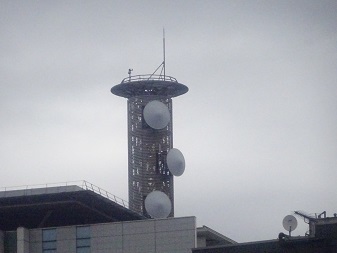
Chiba Prefectural Police headquarters from Hon-Chiba Station. The nearer antenna probably faces Mount Kanozan, the one on the right Mount Sekison.
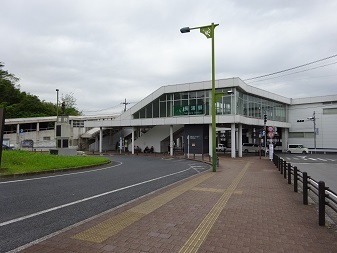
Approaching from Nagaura Station
Arrived at Nagaura at 9:11. Leaving the station.
Searching from Shufu-no-Mise's rooftop… cannot make it out. It is visible from Aeon's rooftop, but Aeon was not open yet; more below.
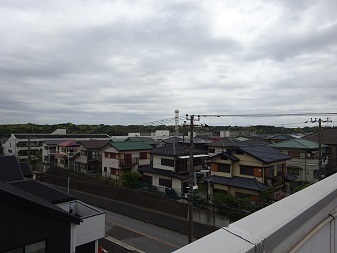
At Satsukidai Home Nursing Station, turn left… there it is! Slimmer than I imagined.
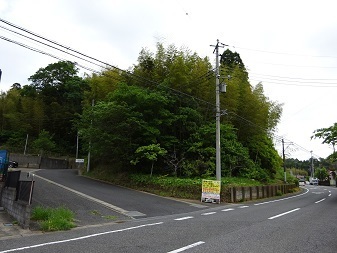
Right at Kubota intersection to approach. Let's try going in here.
That was a mistake.
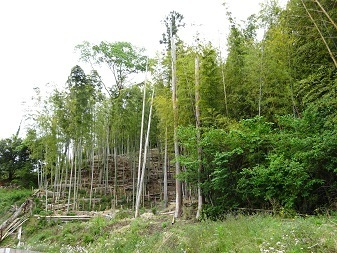
Somehow came out onto a path like this.
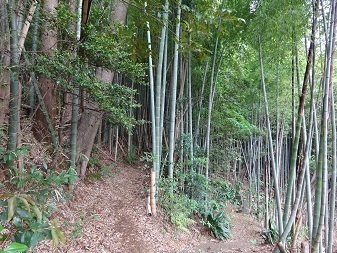
Still, I encountered a triangulation point, though buried. The path does not seem wrong.
[Added May 7: the point name is Uenodai.]
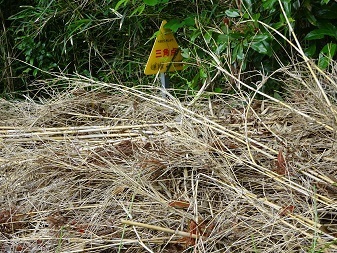
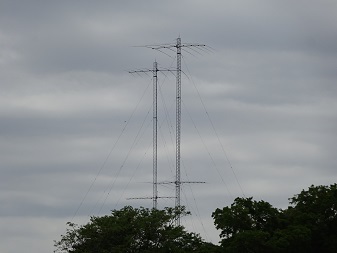
Past it and right/east… there it is.
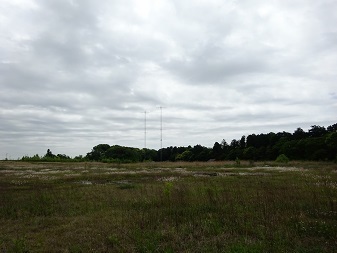
Getting lost while heading left/north. Emerged into a vast clearing—filled land, perhaps?
Detailed observations
Buildings
A house—holiday home?—is visible in the rear left.
While I was photographing, a couple arrived by car.
They told me it is not accommodation for radio-station workers. I nearly wrote an incorrect report.
I wonder about RF exposure protection.
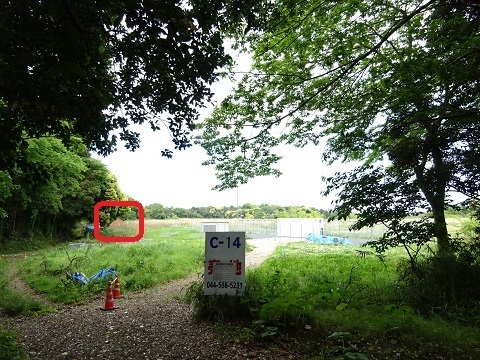
Station building.
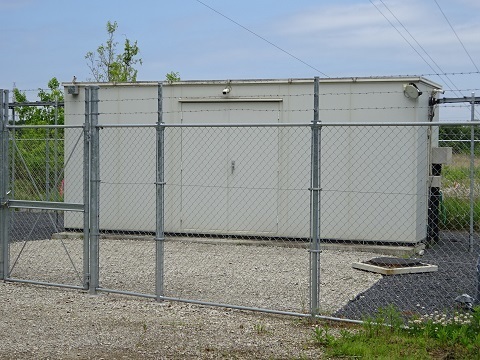
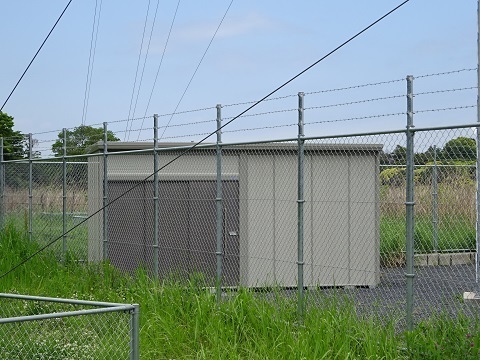
Storehouse.
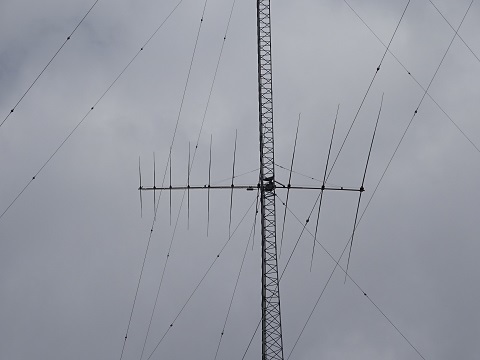
Log-periodics
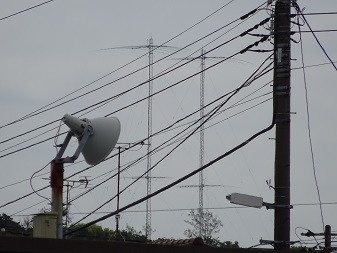
The upper one on the Philippines-bound tower. The rearmost two elements are shortened, but it is unmistakably a log-periodic.
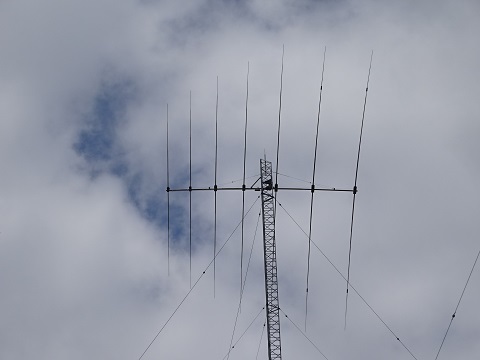
The lower one on the same tower.
An opening at the base of the Chicago-bound tower.
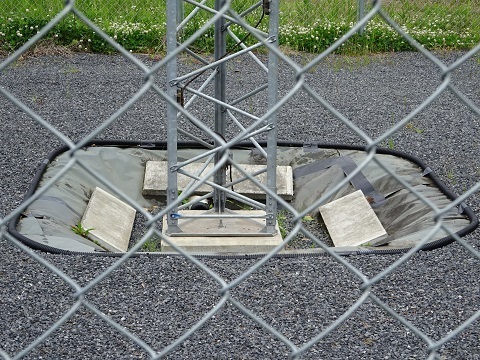
Each has guys in three directions.
Other antennas
Three small antennas on the cable rack linking the station building and eastern tower. SRI for focusing on the fence.
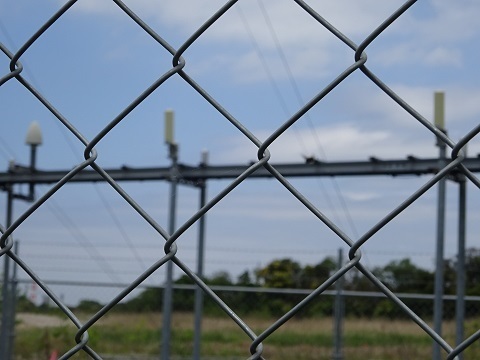
This is GPS, isn't it?
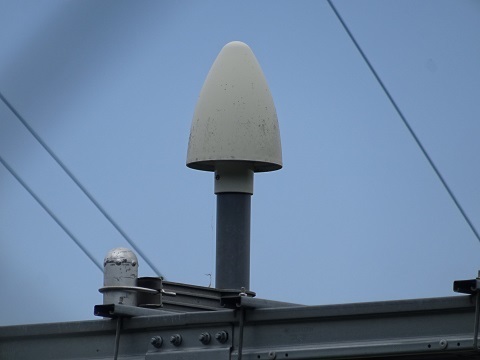
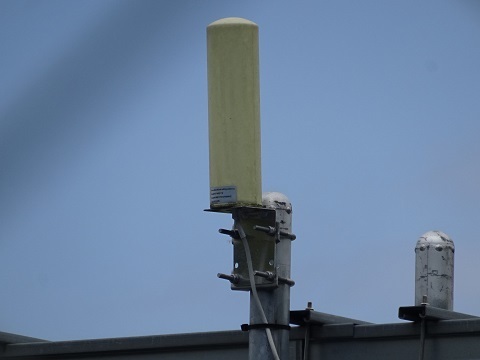
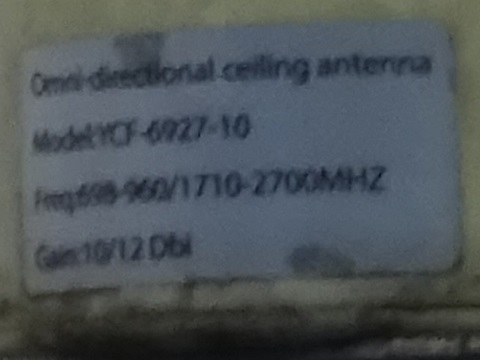
Cellular antennas: two of them.
This facility seems to have no incoming telephone line or FLET'S fibre, so perhaps it connects through the cellular network?
It reads ‘Omni-directional ceiling antenna Model YCF-6927-10’.
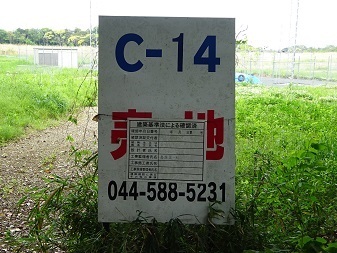
Sign
Reusing a sign from when the land was for sale.
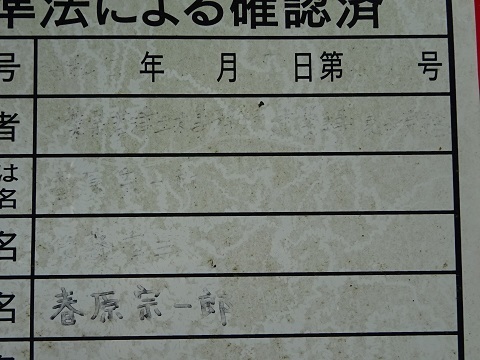
Fading, but this name belongs to an executive listed in DATACOM SERVICES' register.
Surroundings
Entrance from the prefectural road, looking west. If driving, come in here.
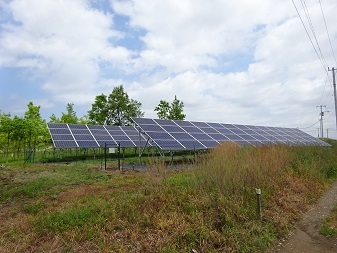
Five rows of solar panels. This address is 3000, Kamioshiro, Kubota. Best to park around here.
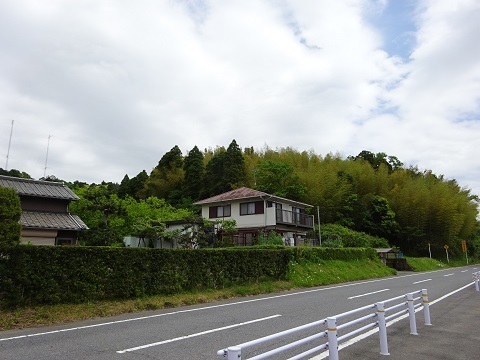
There are graves along the road: the Takeuchi, Suzuki, Imai and Tokita families.
Return: the correct route discovered
A direct climb starts at the road beside the vertical ‘Caution: frequent accidents’ sign at the far right of the photo.
Here:
https://www.google.co.jp/maps/@35.4448722,140.0180106,40m/data=!3m1!1e3
The tower is visible at the far left of the photograph.
A concrete-paved hill path, though covered in fallen leaves. Climb past the Takeuchi family grave on your right—a different Takeuchi family from the one mentioned above—and take the left path at the top.
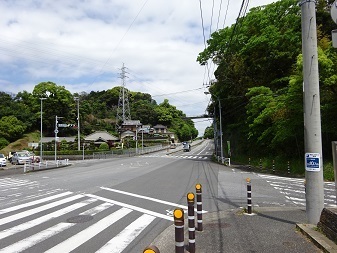
Kubota intersection. Coming from Nagaura Station, behind the camera, turn right here.
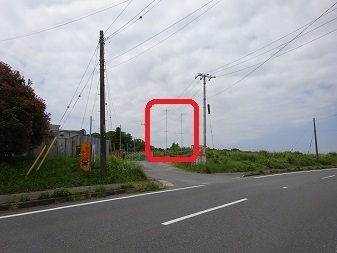
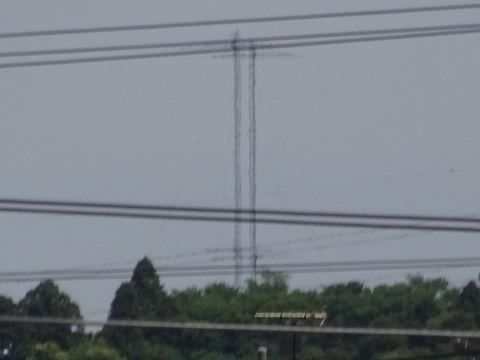
From Aeon's rooftop car park, now open… it is visible, in the red box just left of centre.
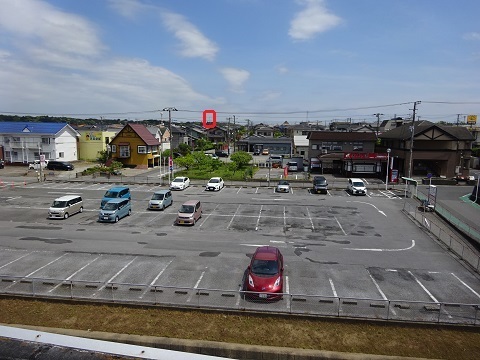
There.
Retreat. Nagaura 12:57 → Soga → Keiyo Line → Tokyo → Tamachi.
MIC deliberations
The Information and Communications Council's Land Radiocommunication Committee, HF Digital Fixed Station Working Group:
is preparing the regulatory framework.
At its third meeting:
document ‘04 [HF Digital Fixed WG 3-6] Approach to technical conditions, etc.’:
https://www.soumu.go.jp/main_content/000870393.pdf
says on page 6:
(2) The examination standards should state, for HF digital fixed stations: ‘Use of this frequency is permitted only where it does not interfere with operation of other radio stations.’ Operation must cease if interference occurs. However, ‘other radio stations’ excludes amateur stations.
Quite provocative wording: ‘Even if amateur stations suffer interference, we will still give you a licence.’
…They will probably be separated from the amateur bands, and JA1CIN chairs the working group, so it should be all right.
JARL is represented by JA1LAS Takai, chair of its Electromagnetic Environment Committee.
Thoughts
Commercial service at this same site?
…Probably.
They would not go out of their way to dismantle it, would they? If they do, lend it to me.
The ground was nicely damp, too.
How will they connect to central Tokyo?
Elevation: 41.5 m.
Can they cross Tokyo Bay by microwave like JOSADA TELECOM?
Can dishes be attached to these rather flimsy-looking towers?
[Added July 9] A microwave licence between Sodegaura City and Koto Ward has been granted ↓.
I revisited on July 8, but found no dishes.
Couldn't they use Nagara?
Two frequencies there are dormant anyway.
It is the Japan ‘Economic’ Newspaper, after all.
If several operators actually try to build communications systems of this kind, the Nagara idea might emerge too—just speculation.
Six operators are seeking to operate.
What is the Chicago-end counterpart?
Here, perhaps?
‘What is the mysterious powerful signal discovered by amateur radio operators?’
https://gigazine.net/news/20210223-amateur-band-intruder/
[Added May 2, 10:00] Identified in Street View: South Lorang Road, Elburn, Illinois.
Not yet shown in satellite imagery.
I cannot say definitively that this is Sodegaura's counterpart.
West side of the road, immediately south of the entrance to Almon Underwood Prairie Nature Preserve.
Higher-layer protocols also matter
With something like TCP using a narrow window, it would all come to nothing.
Comments
Translated from the comments in the archived original HTML. Author names and timestamps are retained as displayed; these are separate from the article.
JK1WLR JF9RPM — 2023-05-02 07:52
Thanks for your hard work and for the report. I had been thinking of visiting the site myself, but your detailed report let me enjoy it already. I would like to receive the signal, look at it on a spectrum analyser, extract the band and analyse it.
If you are going to Interop, I would like to look out for you.
塩谷 — 2023-05-10 23:06
I found your analysis of YOSADA useful. The other location in Koto Ward looks suspicious:
It is a satellite company, though…
JJ1WTL — 2023-06-03 10:03
Scheduled to speak: June 15, the second day of the event, 12:05–12:25, ShowNet stage.