The current position of JB and JC callsigns
Original: Ryota / JJ1WTL — 201110article_7 · Original Japanese HTML
Published: 2011-10-09
English translation of the archived article text. The author’s first-person observations, uncertainty and later additions are preserved; this is not the research summary. Image contents are preserved as images, not silently incorporated into the translated prose.
The subject also came up in questions at the general meeting, and I think I now understand it clearly. That is because I happened to find the following document: an ITU compilation of callsign formats for amateur and experimental stations in each country.
Annex to ITU Operational Bulletin No. 867 - 1.IX.2006 BR RADIOCOMMUNICATION BUREAU OF ITU STATUS OF RADIOCOMMUNICATIONS BETWEEN AMATEUR STATIONS OF DIFFERENT COUNTRIES (In accordance with optional provision No. 25.1 of the Radio Regulations) AND FORM OF CALL SIGNS ASSIGNED BY EACH ADMINISTRATION TO ITS AMATEUR AND EXPERIMENTAL STATIONS (POSITION ON 1 SEPTEMBER 2006)
It is here: http://www.docstoc.com/docs/81935903/Call-Sign-Formation-Possibilities What does this authoritative document say about Japan? The following:
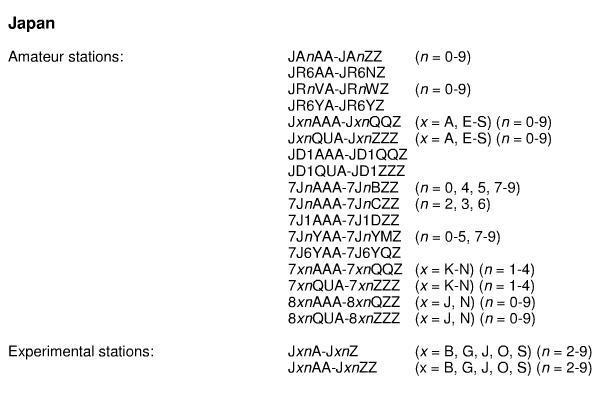
Accordingly, the callsigns currently assigned to experimental stations can be described as:
- JB#A–JB#Z, JB#AA–JB#ZZ.
- JG#A–JG#Z, JG#AA–JG#ZZ.
- JJ#A–JJ#Z, JJ#AA–JJ#ZZ.
- JO#A–JO#Z, JO#AA–JO#ZZ.
- JS#A–JS#Z, JS#AA–JS#ZZ.
Here # is a digit from 2 to 9. That is because 1 and 0 are not used internationally for experimental stations, now termed ‘experimental test stations’ in Japan. Experimental stations are the only stations whose callsigns are constructed in the same way as amateur callsigns. Both take this form:
- National identification + digit + up to four characters.
- The last character must be a letter.
- Temporarily established stations may exceed four characters.
Thus, so long as experimental stations do not use a block, it is vacant from the amateur perspective. That gives us the conclusion:
- JB: everything vacant except one- and two-letter suffixes. Strictly, JB1 and JB0 are entirely vacant, even including those suffixes.
- JC: entirely vacant.
Seen another way, outside JB, JG, JJ, JO and JS, even one- and two-letter suffixes are vacant. Checking the second-letter distinctions in another document, the Radio Act Examination Standards, gives:
- JB: telecommunications carriers.
- JJ: Defense Agency.
- JG: other government agencies.
- JO: broadcasters.
- JS: others.
Those standards also give these suffix-allocation ranges:
- Stations handled by the central ministry: A–Z, AA–ZZ.
- Stations delegated to regional authorities: as follows.
JB, JG, JJ and JO
- Kanto: 2XA–XZ, WA–WZ, ZA–ZZ.
- Shinetsu: 2YA–YZ.
- Tokai: 3XA–XZ.
- Hokuriku: 3YA–YZ.
- Kinki: 4XA–XZ.
- Chugoku: 5XA–XZ.
- Shikoku: 6XA–XZ.
- Kyushu: 7XA–XZ.
- Tohoku: 8XA–XZ.
- Hokkaido: 9XA–XZ.
- Okinawa: 7YA–YZ.
JS
- Kanto: JS2RA–YZ.
- Shinetsu: JS2ZA–ZZ.
- Tokai: JS3XA–YZ.
- Hokuriku: JS3ZA–ZZ.
- Kinki: JS4WA–ZZ.
- Chugoku: JS5XA–YZ.
- Shikoku: JS6XA–XZ.
- Kyushu: JS7XA–YZ.
- Tohoku: JS8XA–YZ.
- Hokkaido: JS9XA–YZ.
- Okinawa: JS7ZA–ZZ.
For regionally delegated stations, we can see that one-letter suffixes are not assigned, and even within the two-letter space, most remains vacant. The allocation space has probably been reduced this way because most experimental stations have moved to spoken identification names such as ‘JARL Experiment’, rather than callsigns. As mentioned above, the regional digits differ from amateur area numbers because experimental stations cannot use 1 or 0. The same regional digits apply to stations handled by the central ministry. Actual searches in Radio Station Information Search produce examples such as:
- JG8XA: National Institute of Technology, an independent administrative institution; educational use, Sendai College.
- JS2SH / JS2SI: Ryokuseisha Co., Ltd.; experimental/testing use.
- JG2XA: University of Electro-Communications, a national university corporation; educational use, the HF Doppler experimental station on 5006 and 8006 kHz.
- JG7XB: Saga Prefecture; educational use.
So, should we introduce qualification-based callsigns and/or vanity callsigns, as in the United States? For the former: now that licence details are public through Radio Station Information Search, perhaps there is little prospect of that. And intuitively, I doubt there is enough capacity. For the latter: perhaps there might be a possibility in future, as a revenue-raising measure to reduce the national deficit.
The following is only for those who get it—ha ha!
Bonus 1


From CQ ham radio, February 1962.
Bonus 2
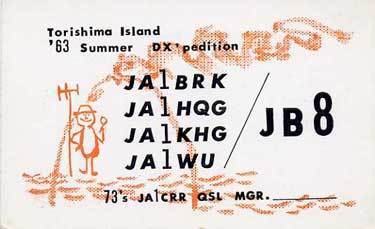
Bonus 3
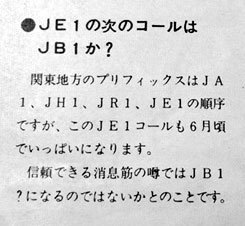
From Ham Life, May 1972. Thanks to JG1KYL.
Bonus 4
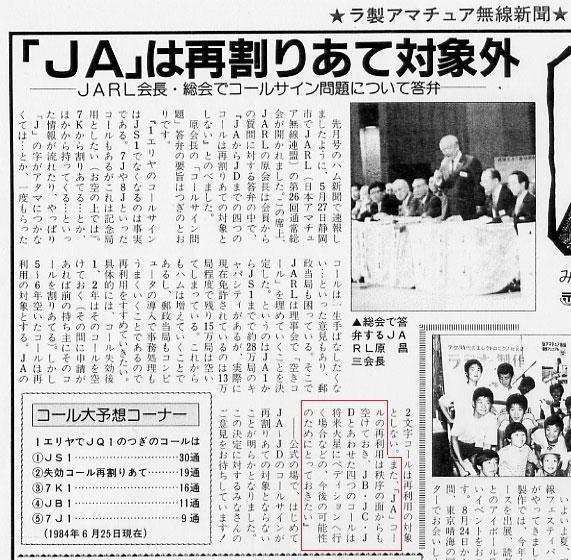
From Radio no Seisaku, August 1984. This reply subsequently gave rise to the theory that ‘JB and JC are for Mars’.