Public consultation: Frequency Reorganization Action Plan
Original: Ryota / JJ1WTL — 505025188 · Original Japanese HTML
Published: 2024-09-30
English translation of the archived article text. The author’s first-person observations, uncertainty and later additions are preserved; this is not the research summary. Image contents are preserved as images, not silently incorporated into the translated prose.
Comments are being invited on the subject in the title: ‘Invitation for comments on the draft Frequency Reorganization Action Plan, FY2024 edition’. https://www.soumu.go.jp/menu_news/s-news/01kiban09_02000526.html This time there is a section specifically devoted to amateur radio, so take note. The following is an extract from PDF pages 35–36 of 41: https://www.soumu.go.jp/main_content/000969386.pdf
IX. Other initiatives concerning frequency reorganization and spectrum use
[Omitted]
(12) Examination of frequency allocation, sharing and related matters in amateur-radio bands
The number of amateur-radio users has declined to close to one quarter of its peak. Based on the Radio Regulatory Council's evaluation of the effectiveness of spectrum use, efforts to broaden the base of people developing wireless skills will continue. At the same time, taking account of international trends in spectrum use, demand for new radio systems and the circumstances of amateur radio, consideration will be given to reviewing amateur-radio frequency allocations as a whole and promoting further sharing.
The following will be examined as immediate issues:
- In 10.1–10.15 MHz, examine sharing with the fixed service, taking account of new international demand for spectrum use and international allocations.
- In 1260–1300 MHz, reflect the WRC-23 resolution in the Frequency Allocation Plan by making amateur and amateur-satellite operation conditional on not causing harmful interference to receivers of the radionavigation-satellite service, space-to-Earth, sharing the frequencies.
- In 2400–2450 MHz, 5650–5850 MHz and 10.1–10.25 GHz, conduct a review in light of the low or absent use of certain categories of frequencies assigned to amateur relay stations in the so-called band plan, the operating-regulations notice. Also, taking account of international spectrum-use trends, demand for new radio systems and the circumstances of amateur radio, advance consideration of a future review of the band plan as a whole, including these bands, and the promotion of further sharing.
- In 10.45–10.5 GHz, 24–24.05 GHz and 47–47.2 GHz, consider making these frequencies available for designated experimental test stations.
[Remainder omitted.]
…Let’s unpack it. Apologies for the length.
General points: reviewing overall frequency allocations and promoting further sharing
IX. Other initiatives concerning frequency reorganization and spectrum use
[Omitted]
(12) Examination of frequency allocation, sharing and related matters in amateur-radio bands
The number of amateur-radio users has declined to close to one quarter of its peak. Based on the Radio Regulatory Council's evaluation of the effectiveness of spectrum use, efforts to broaden the base of people developing wireless skills will continue. At the same time, taking account of international trends in spectrum use, demand for new radio systems and the circumstances of amateur radio, consideration will be given to reviewing amateur-radio frequency allocations as a whole and promoting further sharing.
I will divide this into three points:
(1) The decline
Yes, the numbers are falling. 358,068 at the end of FY2023 ÷ 1,364,316 at the end of FY1994 = 26%, approximately one quarter.
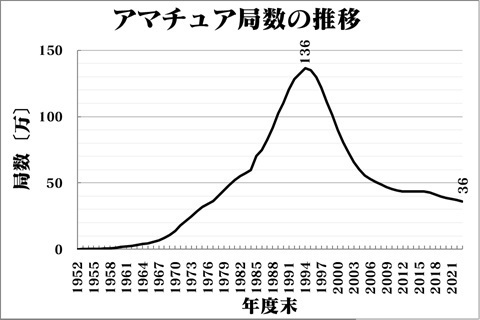
[Ministry of Internal Affairs and Communications sources: ‘Changes in the number of amateur radio stations’, an Excel download: https://www.tele.soumu.go.jp/resource/j/others/amateur/transition.xlsx ‘Information and Communications Statistics Database’, supplying the end-FY2023 figure: https://www.soumu.go.jp/johotsusintokei/field/denpa02.html.]
(2) Reviewing frequency allocations
Hardly a situation in which it is easy to say, ‘Please give us another band.’
(3) Promoting further sharing
The following two proposals have already appeared in the past two months.
Wind-profiler radar The 6 m band. Amateur radio is a primary service, also termed a primary allocation; the amateur side has the stronger position. ‘Public consultation: Frequency Allocation Plan’: https://jj1wtl.seesaa.net/article/504174724.html
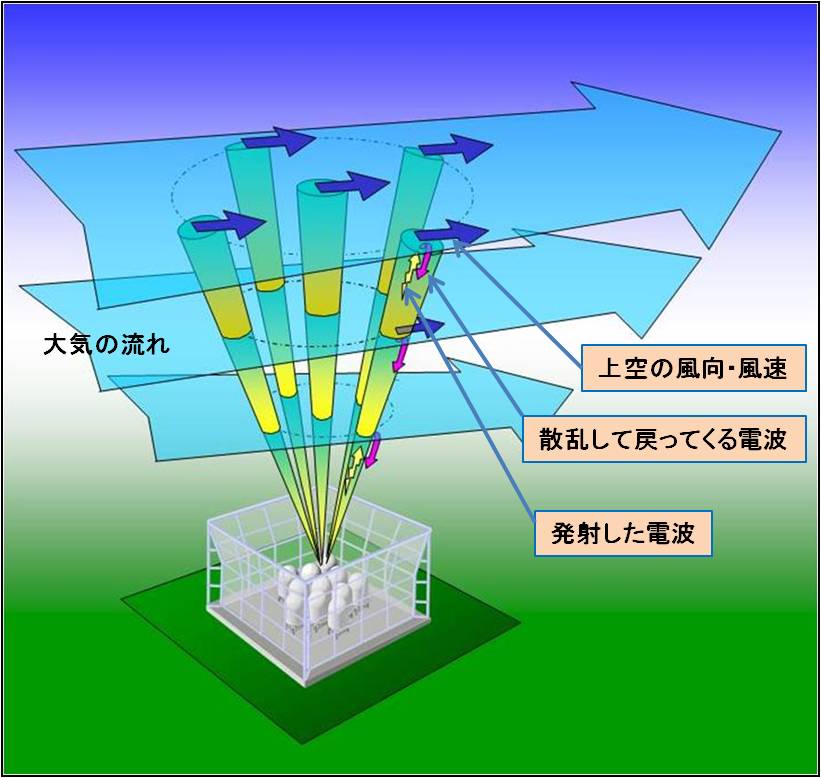
[Linked source: https://www.jma.go.jp/jma/kishou/know/windpro/wprgenri.jpg.]
Tyre-pressure monitoring systems, TPMS, and remote keyless entry, RKE 433.92 MHz. The amateur service is primary. ‘Public consultation: TPMS and RKE at 433.92 MHz’: https://jj1wtl.seesaa.net/article/504772516.html
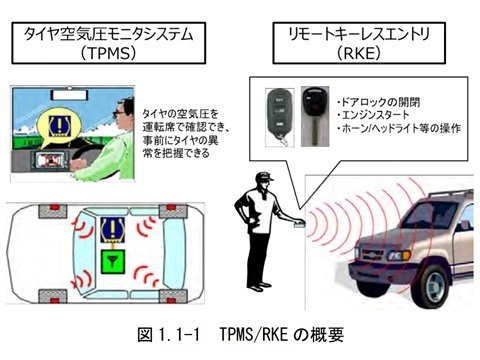
[Quoted from the draft Land Radiocommunications Committee report, ‘Technical conditions for 433 MHz tyre-pressure monitoring and remote keyless entry’.]
The 10 MHz band
The following will be examined as immediate issues:
- In 10.1–10.15 MHz, examine sharing with the fixed service, taking account of new international demand for spectrum use and international allocations.
By ‘fixed service’, do they mean those digital HF fixed stations for financial trading, with lower latency than fibre? They are mentioned on page 14 of the same 41-page document. The discussion had seemed stalled for a while, but now it says technical conditions will finally be drawn up during this fiscal year:
- Initiatives towards establishing the regulatory framework
[Omitted]
(2) Digital HF communications, 3–30 MHz
(i) Taking account of the adoption of digital HF systems overseas and related developments, compile technical conditions for introducing digital systems into international HF communications by fixed stations, aiming to do so during FY2024.
[Remainder omitted.]
There is already a suspicious warbling signal* occupying the 10.130 MHz range, though. In the 10 MHz band, the amateur service is secondary: the weaker position.
- Digital HF fixed stations are said to use bandwidths such as 12 or 48 kHz, so they are quite different from that warbling signal.
For a Chicago link, wouldn't a somewhat higher frequency be better? For winter? For Asian links? Preparations are currently proceeding under experimental test licences: ‘The new JB2XH’. https://jj1wtl.seesaa.net/article/504743515.html (English translation)
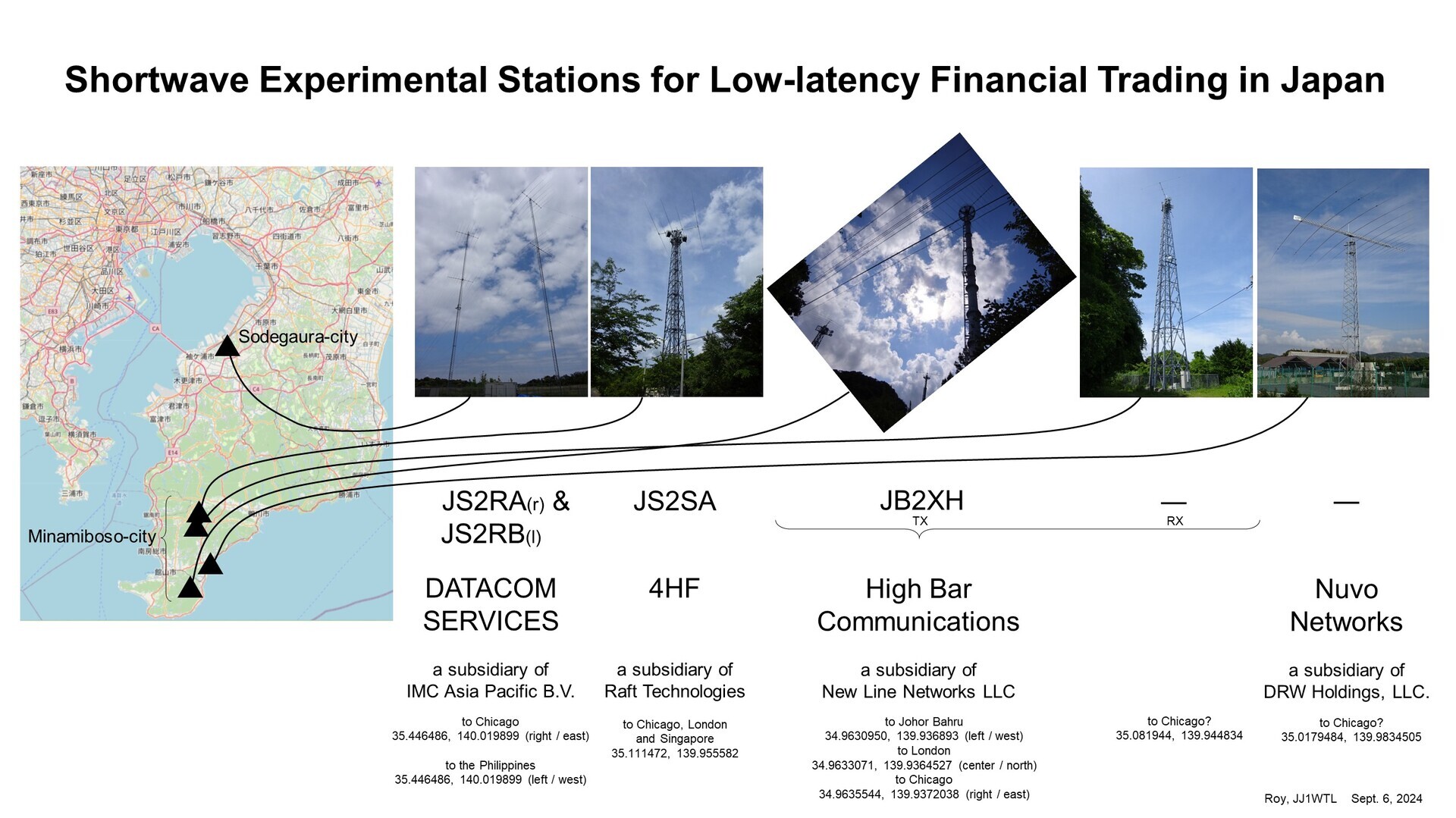
Digital HF fixed stations are positioned so that interference they cause to amateur stations gets a free pass.
The 1200 MHz band
- In 1260–1300 MHz, reflect the WRC-23 resolution in the Frequency Allocation Plan by making amateur and amateur-satellite operation conditional on not causing harmful interference to receivers of the radionavigation-satellite service, space-to-Earth, sharing the frequencies.
The discussion had seemed to stall after WRC-23, but serious action is finally beginning. In the worst case, except at the band edges, it will effectively be reduced to specified-low-power operation.
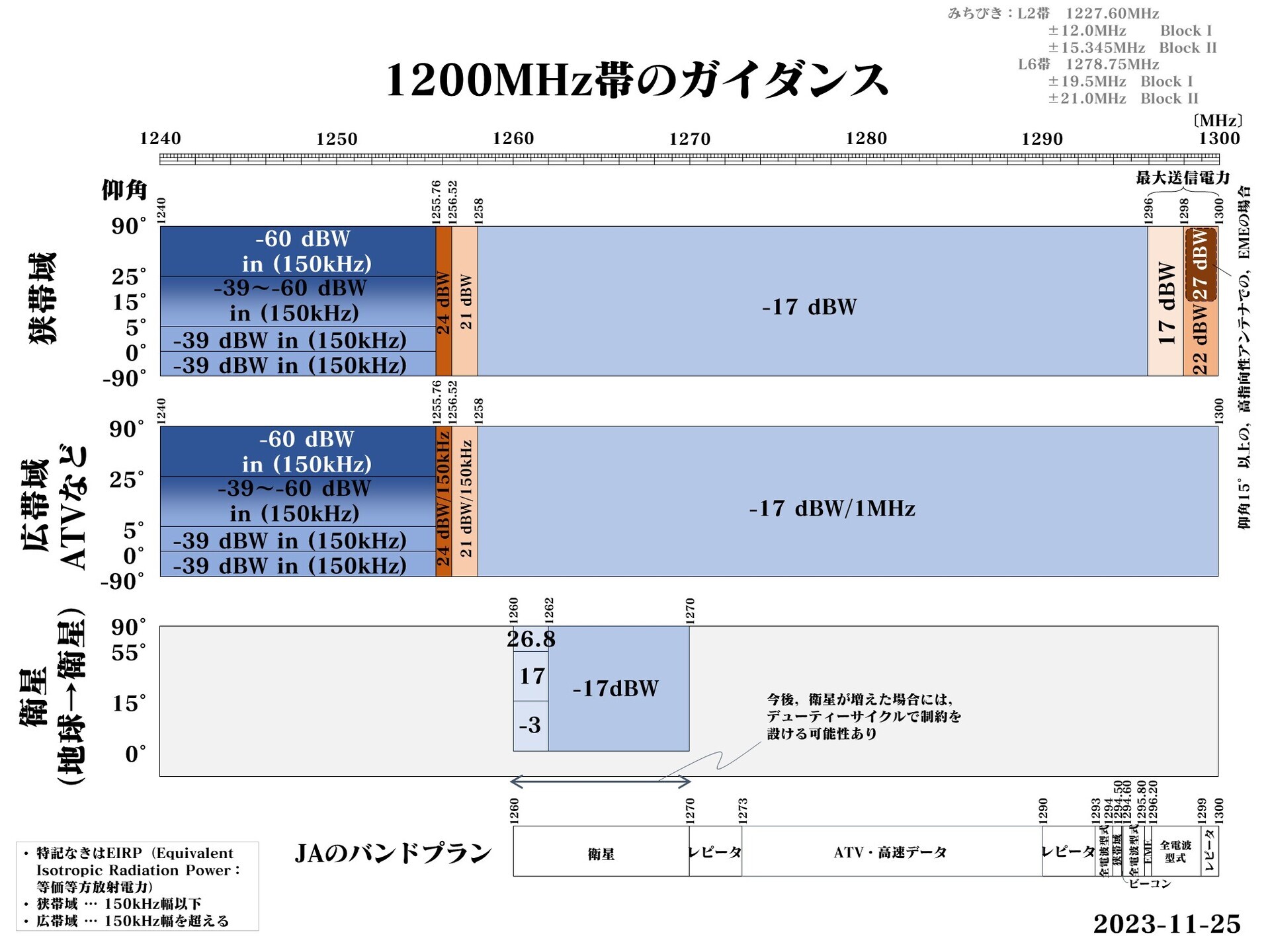
The amateur/JARL position is: ‘We have reduced the repeater power to QRP as instructed, so please let that be enough, honoured officials.’ ‘WRC-23 breaking report: new restrictions on the 1200 MHz band’: https://jj1wtl.seesaa.net/article/501522199.html The amateur service is secondary in the 1200 MHz band.
The 2.4, 5.6 and 10.1 GHz bands
- In 2400–2450 MHz, 5650–5850 MHz and 10.1–10.25 GHz, conduct a review in light of the low or absent use of certain categories of frequencies assigned to amateur relay stations in the so-called band plan, the operating-regulations notice.
It seems you read my preparatory submission and public comments. Thank you. At 5.6 GHz, a total of 50 MHz is being monopolized for just six stations in Kyoto and Aichi. Wouldn't it be better to let drones, the principal source of actual demand in this band, use it?
[G.2] Regarding “2.(12) and (15), Requests to the Ministry of Internal Affairs and Communications”: open the 5.6 GHz repeater band to drones through negotiations with the ministry. In practice, a total of 50 MHz is reserved exclusively nationwide for only six stations in Kyoto and Aichi, under the new notice scheduled to take effect in September. To develop wireless and drone skills, shouldn't sharing be permitted for drones, which account for the main actual demand in this band? In Europe and America, in particular, the six channels shown below are used as ‘Raceband’, plus 5,880 and 5,917 MHz outside Japan's amateur band. This proposal would open the way to their use and international harmonization.

[Preparatory submission for the 2023 general meeting of member representatives.]
In Annex 12, ‘Designation of emission types and frequency-use categories for the amateur service’, add wording to note 11 such as: ‘However, frequencies from 5,650 MHz to 5,850 MHz may be used by small unmanned aircraft and similar devices, provided they do not interfere with operation of the League's relay stations.’ In practice, the League has only six relay-related stations in the 5,750 MHz band nationwide, all in Aichi and Kyoto: three repeaters in Aichi, one in Kyoto, and one pair of two auxiliary stations in Nagoya City. If the aim is to develop wireless and drone skills, rather than restrict 50 MHz nationwide for six stations in two prefectures, that spectrum should be used effectively by drones, the main actual users of the band. In Europe and America, Raceband channels are set at 5,658, 5,695, 5,732, 5,769, 5,806 and 5,843 MHz, plus 5,880 and 5,917 MHz outside Japan's amateur band. Taking occupied bandwidth into account, this relaxation would enable the four middle channels, excluding the two ends, and thus international harmonization. [Public comment submitted in December 2022.]
Drone pilots: please submit comments in favour. ‘Stations licensed only for 5.6 GHz, follow-up—final’: https://jj1wtl.seesaa.net/article/502266644.html
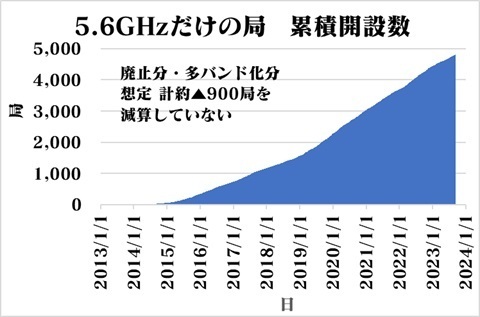
Repeater deployment, including the other bands, is as follows:
| Band | Number of stations | List |
|---|---|---|
| 2.4 GHz | 46* † | http://motobayashi.net/repeater/rep24.html |
| 5.6 GHz | 4* | http://motobayashi.net/repeater/rep56.html; also one link between auxiliary stations |
| 10.1 GHz | 3 | http://motobayashi.net/repeater/rep10.html; also ten auxiliary-station links in six areas |
- JR1WB Otemachi is excluded because it is absent from the repeater-station list in the callsign directory.
† JARL's website, https://www.jarl.org/Japanese/A_Shiryo/A-1_Repeater/list/ushweb.pdf, says 39 stations. An audit is needed once in a while…
The band plan as a whole
Also, taking account of international spectrum-use trends, demand for new radio systems and the circumstances of amateur radio, advance consideration of a future review of the band plan as a whole, including these bands, and the promotion of further sharing.
One concrete example: JARL invited comments on harmonizing the 7 MHz band with neighbouring countries: ‘Invitation for comments on the IARU Region 3 HF Band Plan Committee's proposed 40 m band-plan revision’. https://www.jarl.org/Japanese/4_jarl/4-4_info/R3_40mBandPlan1.html Could the eventual outcome be something like ‘All emission types; the rest is up to you amateurs’?
The 10.4, 24 and 47 GHz bands
- In 10.45–10.5 GHz, 24–24.05 GHz and 47–47.2 GHz, consider making these frequencies available for designated experimental test stations.
[Remainder omitted.]
The direction is towards sharing with designated experimental test stations: experimental stations that can be established quickly through a simplified process.
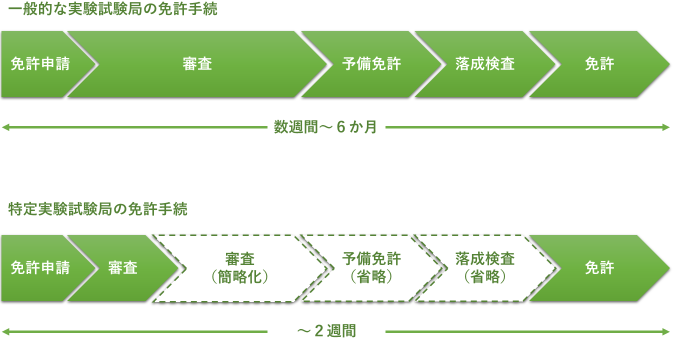
[Quoted/linked source: ‘Designated experimental test stations’: https://www.tele.soumu.go.jp/j/sys/spexp/.]
That is all. —···— Related to this Frequency Reorganization Action Plan: as of today, Monday, September 30, 4.9–5.0 GHz has been allocated to mobile-phone use. The existing 11j users will have to move out. Without delay, the call has gone out: ‘Anyone interested, raise your hand!’ ‘Opening of applications for approval of specified base-station deployment plans to promote fifth-generation mobile communications systems in the 4.9 GHz band’: https://www.soumu.go.jp/menu_news/s-news/01kiban14_02000662.html At the same time, a framework has been established for 5G relay stations, such as repeaters placed by a home's window, and other matters. This is through the ‘Ministerial ordinance partially amending the Radio Act Enforcement Regulations and related provisions’, 2024 ministerial ordinance No. 89, along with 2024 notices Nos. 275–294 and directive No. 36.