JB2XI
Original: Ryota / JJ1WTL — 505733007 · Original Japanese HTML
Published: 2025-06-19T07:36:00+09:00
English translation of the archived article text. The author’s first-person observations, uncertainty and later additions are preserved; this is not the research summary. Image contents are preserved as images, not silently incorporated into the translated prose.
Following the Radio Station Information Search update at 05:20 on Thursday, June 19, I am adding another experimental HF digital fixed station.
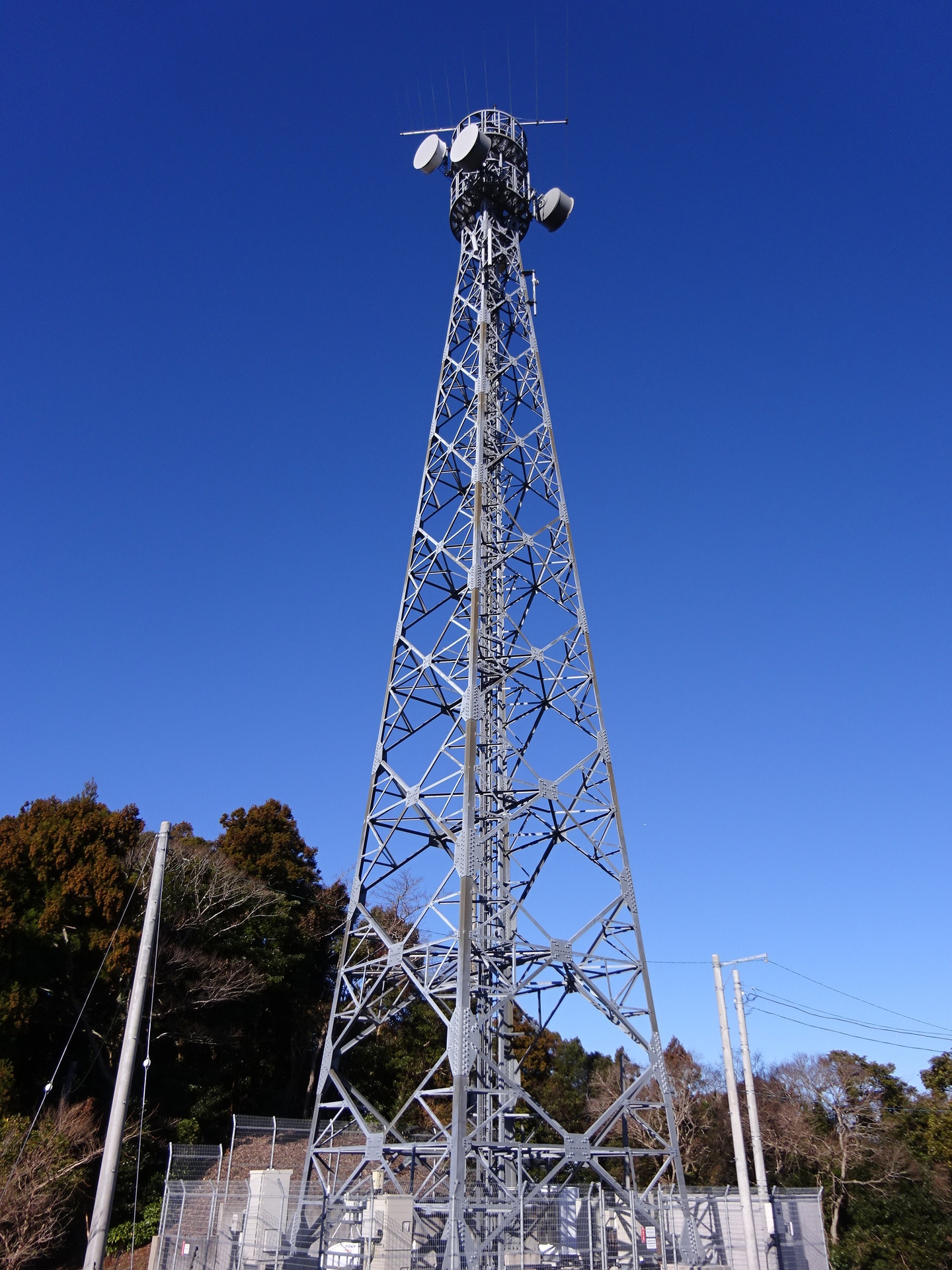
I identify it as this station ↓, which I have been watching as ‘the log-periodic at Cosmo Classic Club’ (click to enlarge, 2.47 MB):
From the Radio Station Information Search
https://www.tele.soumu.go.jp/musen/SearchServlet?pageID=4&IT=A&DFCD=0004567854&DD=1&styleNumber=21
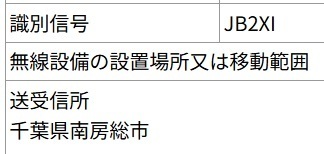
Copied below, with boundary lines in the emission/frequency/power section to make the divisions clear.
Licensee: GT Technologies Japan GK. Licensee address: *****. Station category: experimental station. Licence number: *****. Licence issued: June 16, 2025. Valid until March 31, 2027. Purpose: experiments and tests. Permitted operating hours: continuous. Communications: matters relating to experiments, tests or investigations, excluding Argos-system data transmission
and education. Correspondent: receiving equipment belonging to the licensee near Johor Bahru, Malaysia. Identification signal: JB2XI. Installation location or operating area: Transmitting station:
Minamiboso City, Chiba Prefecture. Monitoring/control station:
Overseas, overseas. Emission classes: 12K0D1D, 12K0F1D, 12K0G1D. Frequencies: 9081, 9126, 10845, 10953, 12117, 12159, 14673, 14736, 16119, 16209 kHz. Antenna power: 2 kW. Remarks: blank.
The photographed log-periodic's beam points southwest, matching the licensed counterpart.
The tower also belongs to the company.
It is used for low-latency microwave service between the cable landing station and central-Tokyo data centres, faster than fibre by the factor associated with glass's refractive index.
Comparing all stations
An update to the table in the earlier post ‘JS2SB’:
https://jj1wtl.seesaa.net/article/505386673.html (English translation)
That table is updated here.
Even if experiments can get by with shared frequencies, can they really secure ‘12 kHz × seven companies × six frequency bands × both directions’, however much the HF bands have emptied out?
| Field | JS2RA | JS2RB | JS2SA | JB2XH | JS2SB | JB2XI |
|---|---|---|---|---|---|---|
| Operator | DATACOM SERVICES | DATACOM SERVICES | 4HF | High Bar Communications | Sora Communications | GT Technologies |
| Location | Kubota, Sodegaura City | Kubota, Sodegaura City | Cosmo Classic Club, Minamiboso City | TX: Kawado, Chikura-cho, Point 120 m RX: Gotenyama / Takatoriyama | Kokubo, Futtsu City | Cosmo Classic Club, Minamiboso City |
| Licence issued | 2021-09-15 → 2024-01-01* | 2023-01-25 → 2024-01-01* | 2023-06-07 → 2024-01-01* | 2023-07-28 → 2024-01-01* | 2024-10-22 | 2025-06-16 |
| Valid until | 2023-12-31 → 2027-03-31* | 2023-12-31 → 2027-03-31* | 2023-12-31 → 2027-03-31* | 2023-12-31 → 2027-03-31* | 2027-03-31 | 2027-03-31 |
| Counterparts | Chicago, USA | Philippines | Chicago, USA; Singapore; London, UK | Johor Bahru, Malaysia; Chicago, USA†; London, UK† | Near Hong Kong (VS6); Batam, Indonesia; Johor, Malaysia | Near Johor, Malaysia |
| Emission | 12K0A1D | 10K0A1D | ||||
| Emission | 12K0D1D | 12K0D1D | 12K0D1D | 10K0D1D, 10K0D7D | 12K0D1D | |
| Emission | 12K0F1D | 10K0F1D, 10K0F7D | 12K0F1D | |||
| Emission | 12K0G1D | 12K0G1D | 12K0G1D | 12K0G1D | 10K0G1D, 10K0G7D | 12K0G1D |
| Emission | 12K0K1D | |||||
| Frequency (kHz) | 6864 | 6864 | 6864** | 6864** | 6864 | |
| Frequency (kHz) | 6900 | 6900 | 6900 | 6900 | ||
| Frequency (kHz) | 9081 | 9081 | 9081** | 9081** | 9081 | 9081 |
| Frequency (kHz) | 9126 | 9126 | 9126 | 9126 | 9126 | |
| Frequency (kHz) | 10845 | 10845 | 10845** | 10845** | 10845 | 10845 |
| Frequency (kHz) | 10953 | 10953 | 10953 | 10953 | 10953 | |
| Frequency (kHz) | 12117 | 12117 | 12117** | 12117** | 12117 | 12117 |
| Frequency (kHz) | 12159 | 12159 | 12159 | 12159 | 12159 | |
| Frequency (kHz) | 14673 | 14673 | 14673** | 14673** | 14673 | 14673 |
| Frequency (kHz) | 14736 | 14736 | 14736 | 14736 | 14736 | |
| Frequency (kHz) | 16119 | 16119 | 16119** | 16119** | 16119 | 16119 |
| Frequency (kHz) | 16209 | 16209 | 16209 | 16209 | 16209 | |
| Antenna power | 10 kW | 5 kW | 3 kW | 10 kW → 1.5 kW†† | 8 kW, 8 kW | 2 kW |
| Antennas*** | 7-element low-band upper array + 10-element high-band middle array | 7-element low-band upper array + 10-element high-band middle array; 5-element Yagi below on JS2RA's tower | 5-element Yagi | TX: 13 elements on each of three towers; RX: 13 elements | Two ten-element arrays on each of two towers | 10 elements |
*: Licence renewed.
†: Additional counterpart destination.
**: Additional frequency.
††: Reduced power.
***: Log-periodic unless otherwise stated.
Receive-only operators are omitted for space.
Including these two ↓, seven companies in all:
-
NuVo Networks: the Minamihara log-periodic.
-
Ermis: the loop array at Maeda, Minamiboso City.
Why the callsign starts with JB
Because it is a telecommunications operator.
JB is assigned to telecommunications operators.
The root is the same reason amateurs once jumped from JA to JH, rather than JB.
The company already offers commercial service over its own microwave route.
All use 28M5D7W. My estimated arrangement:
[Shin-Toyosu Cube] ↔ unlicensed link ↔ [No. 5 Inoue Building, 45 mW] —6675 MHz→ / ←6835 MHz— [45 mW, Mother Farm, 6 mW] —7450 MHz→ / ←7610 MHz— [6 mW, Cosmo Classic Club, 6 mW] —7610 MHz→ / ←7450 MHz— [1.4 mW, SoftBank Maruyama International Relay Station].
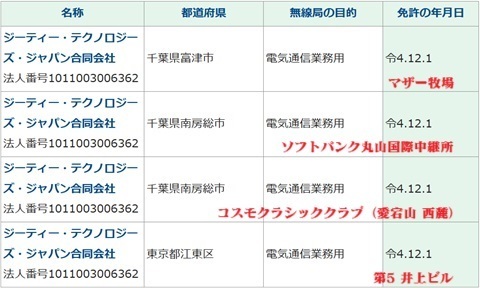
The company's website
『GTT Communications, Inc.』
You would be better off looking here:
That concludes this quick report.
Radio Station Information Search links for each station
●JS2RA DATACOM SERVICES
https://www.tele.soumu.go.jp/musen/SearchServlet?pageID=4&IT=A&DFCD=0004295380&DD=1&styleNumber=21
●JS2RB DATACOM SERVICES
https://www.tele.soumu.go.jp/musen/SearchServlet?pageID=4&IT=A&DFCD=0004448132&DD=1&styleNumber=21
●JS2SA 4HF
https://www.tele.soumu.go.jp/musen/SearchServlet?pageID=4&IT=A&DFCD=0004464656&DD=1&styleNumber=21
●JS2SB Sora Communications
https://www.tele.soumu.go.jp/musen/SearchServlet?pageID=4&IT=A&DFCD=0004467072&DD=1&styleNumber=21
●JB2XH HBC
https://www.tele.soumu.go.jp/musen/SearchServlet?pageID=4&IT=A&DFCD=0004474981&DD=1&styleNumber=21
●JB2XI GTT
https://www.tele.soumu.go.jp/musen/SearchServlet?pageID=4&IT=A&DFCD=0004567854&DD=1&styleNumber=21
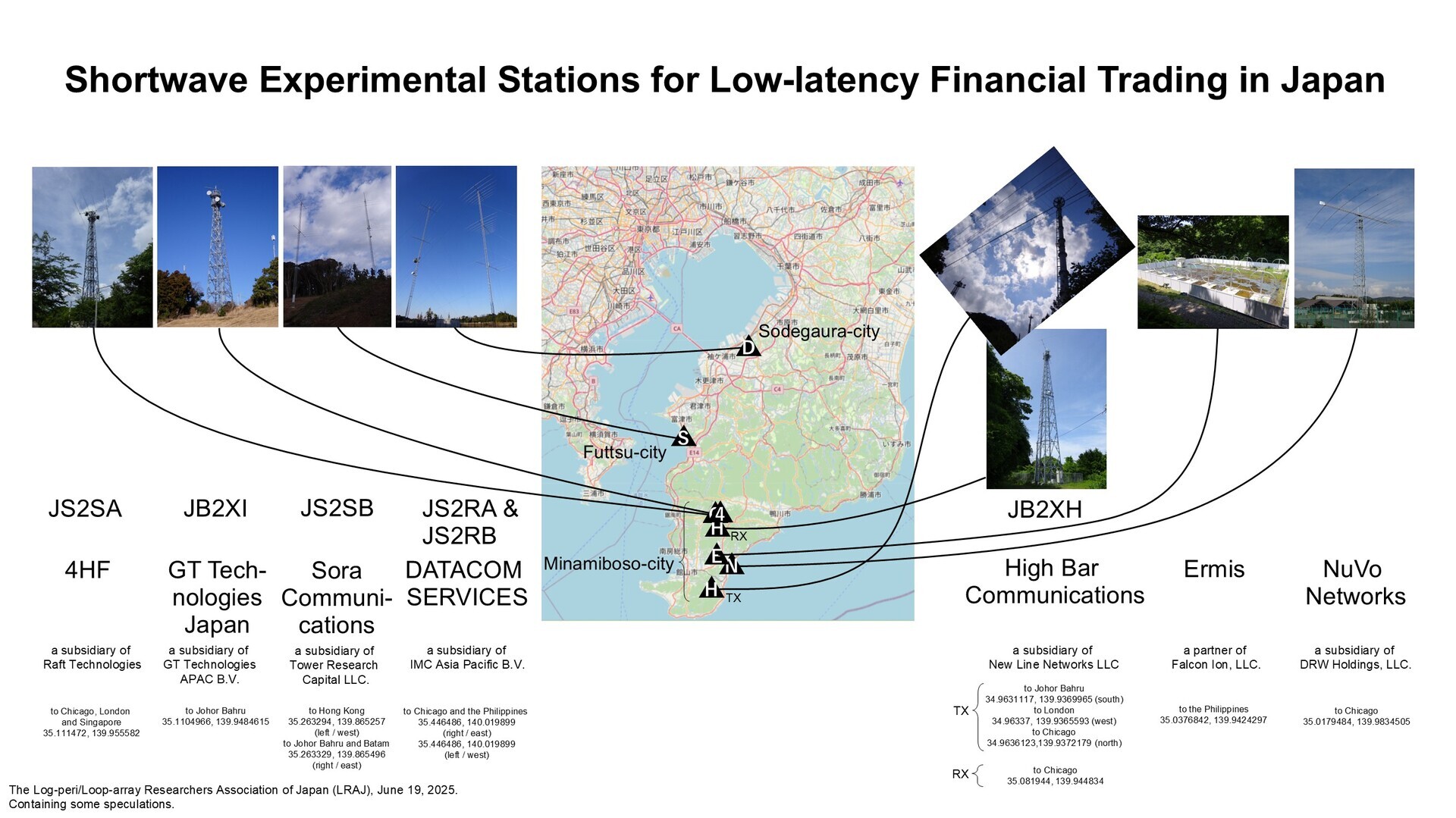
Updated overview diagram
Click to enlarge, 614 KB.
Earlier posts
‘JS2RA / JS2RB’
https://jj1wtl.seesaa.net/article/499204144.html (English translation)
‘JS2RA / JS2RB, continued’ (additional Philippines-bound Yagi)
https://jj1wtl.seesaa.net/article/505776879.html (English translation)
‘JA/CB-004’ (4HF's JS2SA and HBC's JB2XH, later classified as a receive station)
https://jj1wtl.seesaa.net/article/499505940.html (English translation)
‘JS2SA / JB2XH’
https://jj1wtl.seesaa.net/article/500304565.html (English translation)
‘The new JB2XH’ (transmit station)
https://jj1wtl.seesaa.net/article/504743515.html (English translation)
‘JS2SB’ (licence information)
https://jj1wtl.seesaa.net/article/505386673.html (English translation)
‘JS2SB, continued’ (site photographs)
https://jj1wtl.seesaa.net/article/505597775.html (English translation)
‘JS2SB, continued again’ (building application)
https://jj1wtl.seesaa.net/article/511302814.html (English translation)
‘The Minamihara log-periodic’ (NuVo Networks)
https://jj1wtl.seesaa.net/article/501355072.html (English translation)
‘The log-periodic at Cosmo Classic Club’ — the field visit for this station
https://jj1wtl.seesaa.net/article/508688232.html (English translation)
‘The loop array at Maeda, Minamiboso City’
https://jj1wtl.seesaa.net/article/515801449.html (English translation)