Ryota / JJ1WTL: Japanese HF operators, sites, and terrestrial transport
Summary of the selected posts through 23 August 2026, with September registry comparisons. Updated 21 September 2026.
This follows Ryota's observations and changing interpretations, including earlier guesses resolved by later visits. The Japan overview compares the operators; the full article translations retain each original account.
Sources and diagram notation
Ryota combines MIC licence fields, field photographs and equipment labels, corporate/land/building records, and deductions from antenna bearings and network layout. In his diagrams, HBC is High Bar (NLN) and GTT is GT Technologies (Optiver).
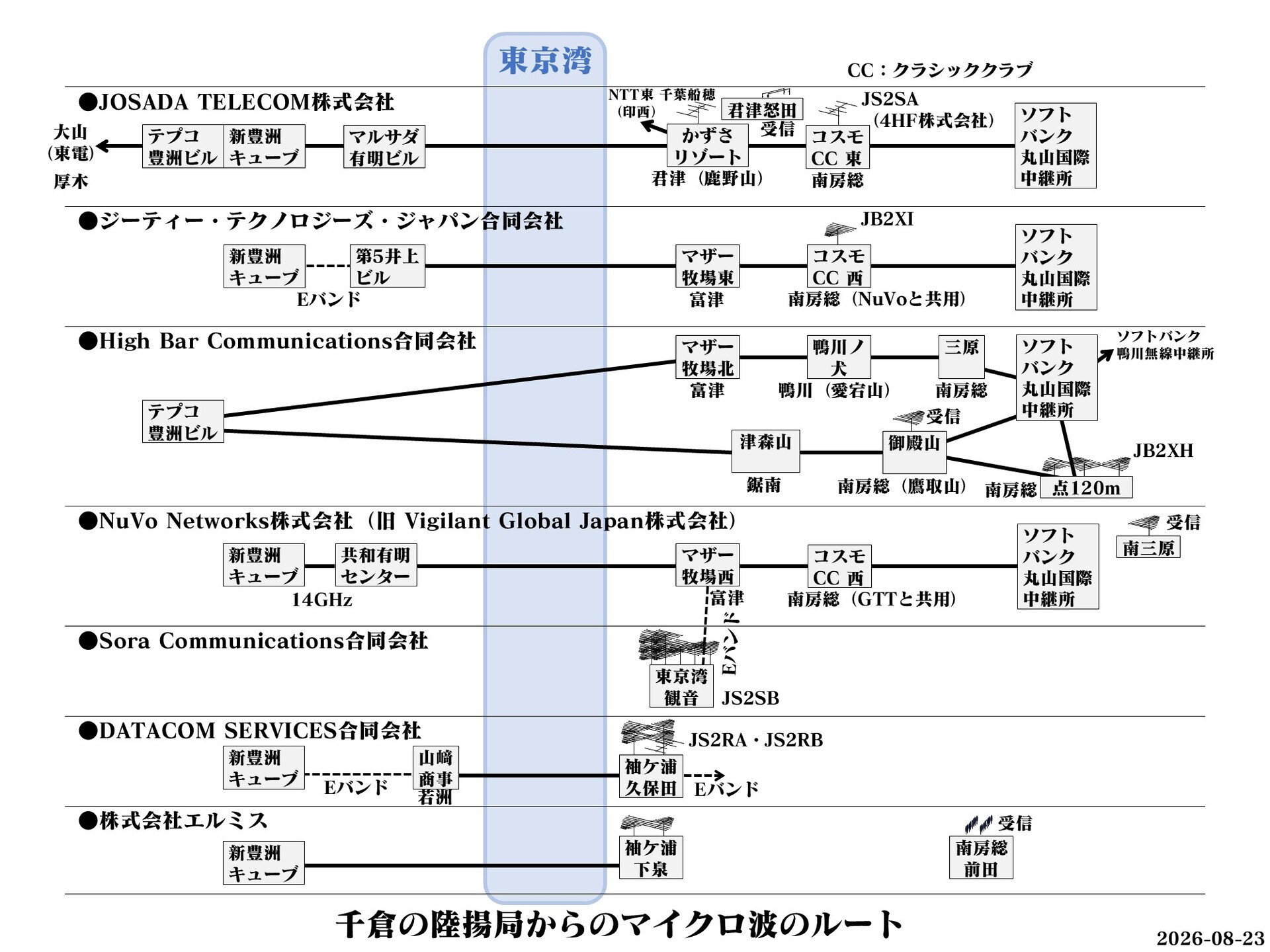
The February 2026 site diagram (English) and August 23 update (English) show the physical sites, including Sora's expansion. The August transport schematic supplies the network rows discussed below.
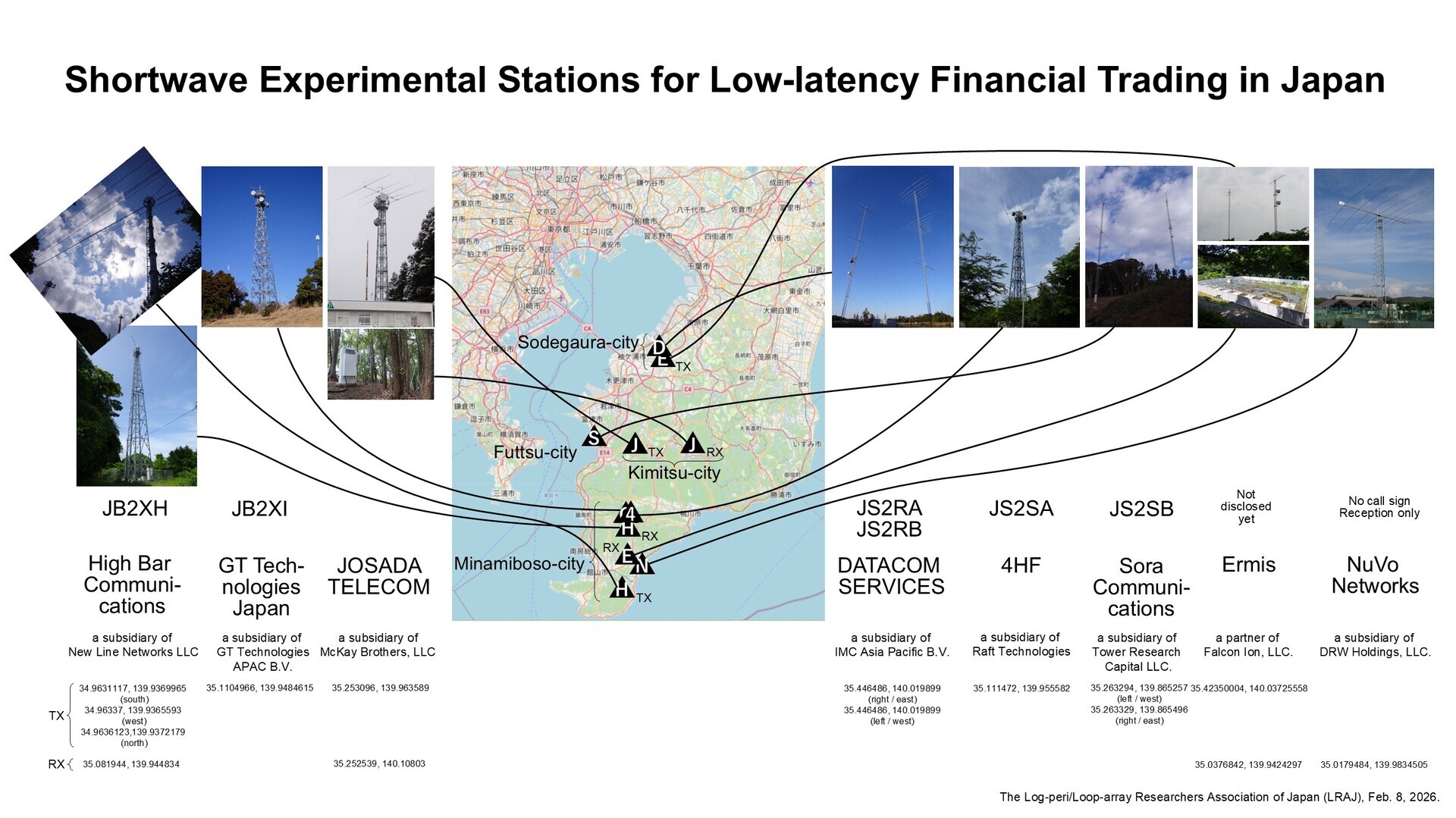
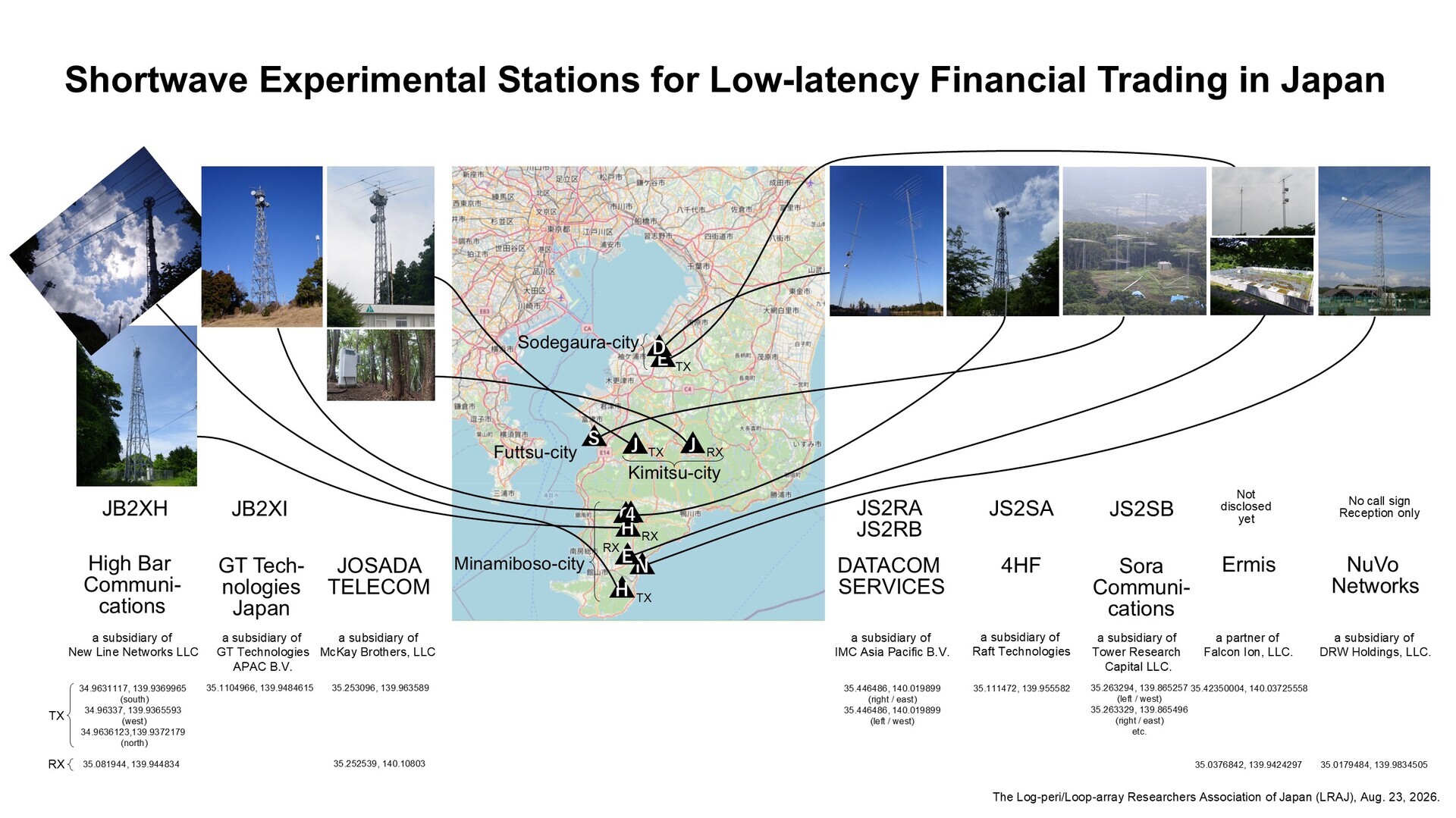
Country labels in his tables are prefixes: W = United States, DU = Philippines, G = United Kingdom, 9V = Singapore, 9M = Malaysia, YB = Indonesia, and VR2 (older text says VS6) = Hong Kong. In particular, Wむけ in the Sora article means US-bound. At Sora, the arrays lie on southwest–northeast axes.
Company relationships, HF licence references and site-identification evidence are collected in Japanese operators and company identities.
Operator/site/callsign matrix
Ryota's August 23 comparison lists six Japanese HF transmitter licensees; DATACOM has two callsigns. JOSADA appears in the receive-site table despite its mounted Kanozan Yagi, because Ryota still reports no full Japanese HF licence there. NuVo remains receive-only. Including JOSADA gives the seven Japanese transmitter sites found in BR IFIC.
| Operator | Japanese HF callsign/site role | Japanese physical site(s) | Foreign counterpart evidence | Domestic transport shown or argued by Ryota |
|---|---|---|---|---|
| DATACOM (IMC) | JS2RA and JS2RB, transmitters at one compound | Kubota, Sodegaura, about 35.4465, 140.0198. East log-periodics serve JS2RA/US; west pair serves JS2RB/Philippines. Between July 2023 and November 2024 the taller east tower also gained a Philippines-facing Yagi. | Japanese licence: JS2RA Chicago; JS2RB Philippines. BR IFIC labels the US receiver Kane, Illinois, 41.8605556, -89.5727778; Philippine receiver 14.1333333, 122.9666667. | Kubota to Yamazaki Shoji Wakasu by fixed microwave; Wakasu to Shin-Toyosu Cube by E-band. The southeast-facing dish at Kubota was photographed in November 2024; the August 2026 schematic still shows an E-band path with no endpoint. |
| 4HF (Raft) | JS2SA transmitter | Cosmo Classic Club East, Minamiboso, about 35.1115, 139.9556; five-element SteppIR HFT540C Yagi on McKay's microwave tower. | Japanese licence: Chicago, Singapore, London. BR IFIC: Chicago and London. | McKay carries Raft's backhaul: the tower's only two microwave dishes are JOSADA's, facing Kanozan and Maruyama, and Ryota's licence table lists no fixed-microwave or E-band licences for 4HF. |
| High Bar (NLN) | JB2XH transmitter plus separate Japanese receive site | TX: Chikura/Kawado Point 120 m, a three-tower cluster around 34.9631, 139.9370. RX: Gotenyama/Takatoriyama, about 35.08195, 139.94476. |
Japanese licence by Aug. 2026: Johor Bahru plus later-added Chicago and London. BR IFIC has the corresponding three receiver areas. | Existing Chikura/Maruyama/Toyosu microwave system plus the northern Ajigaura/Inzai/Kamogawa network documented in 2026 below. |
| Sora (Tower) | JS2SB transmitter | Kokubo, Futtsu, beside Tokyo Bay Kannon, about 35.2633, 139.8654. | Original Japanese licence: Hong Kong, Batam, Johor. By Aug. 2026 table: Seattle and Singapore are marked as additions. BR IFIC has Batam, Hong Kong, and Seattle. | E-band hop to NuVo's Mother Farm West relay, carrying Sora into DRW's terrestrial network. |
| GT Technologies (Optiver) | JB2XI transmitter | Cosmo Classic Club West, about 35.1105, 139.9485; ten-element log-periodic. | Ryota's August table and BR IFIC name Johor. The September MIC response also names Indiana and London. | Shin-Toyosu Cube -- E-band -- No. 5 Inoue Building -- Mother Farm East -- Cosmo CC West -- SoftBank Maruyama International Relay Station. Cosmo West is shown as shared with NuVo at the site level. |
| Ermis (AlberBlanc/FalconIon) | Callsign suppressed in the Japanese public page; transmitter plus separate receive site | TX: Shimoizumi, Sodegaura, about 35.4235, 140.03725, two 12-element arrays. RX: Maeda, Minamiboso, about 35.0377, 139.9424, two rows of eight TCI loops. | Japanese licence: Johor Bahru and “Manhattan.” The BR IFIC coordinate is in the town of Manhattan, Illinois (41.3338889, -87.9577778), not Manhattan in New York City as Ryota guessed. | Ryota infers a direct Shimoizumi--Shin-Toyosu microwave span of 33.3 km from licences, rooftop antenna changes, geometry, and PeeringDB. The Maeda receive site's onward route is not established. |
| JOSADA (McKay) | No full Japanese HF callsign/licence as of Aug. 23, 2026; BR IFIC transmitter plus separate field-identified receiver | TX: Kanozan/Kazusa Resort, about 35.2531, 139.9636, five-element SteppIR HFT540C Yagi mounted by Feb. 8, 2026. RX: Nuda, Kimitsu, 35.252535, 140.108032, two 90 m Beverage wires with a 5 m longitudinal offset and less than 1 m between them; only the B feed was connected at the September 2025 visit. | BR IFIC: Singapore and Hong Kong. Ryota reads the mounted Yagi's west-southwest bearing as pointing toward Singapore. | Existing JOSADA cable-landing/Toyosu route through Kanozan; new 2026 Kanozan--NTT Funaho--SCSK SI1/Inzai branch. Nuda's onward connection is unidentified. |
| NuVo (DRW) | No Japanese HF callsign; receive-only site | Minamihara/Wada-cho Kaihotsu, 35.017979, 139.983428; fourteen-element log-periodic. | Ryota reads the array's bearing as toward Chicago. | Shin-Toyosu Cube -- 14 GHz -- Kyowa Bussan Ariake Center -- Mother Farm West -- Cosmo CC West -- SoftBank Maruyama. Sora connects into the Mother Farm node by E-band. |
Northern route investigations, July–August 2026
The headings below use publication dates. Earlier photographs and dated site visits bracket when equipment appeared.
July 1: Ajigaura and Inzai are endpoints of an HBC expansion
The July 1 article (English) begins from new HBC fixed-service licence entries for Hitachinaka, Kamogawa and Inzai. Ryota's initial map guesses are Ajigaura/Arteria for Hitachinaka, Kiyosumiyama for Kamogawa, and an MC Digital Realty or Colt data centre for Inzai.
At Ajigaura he finds an HBC-labelled cabinet on a tower outside the Arteria compound. Both dishes point roughly south-southwest. An Arteria-labelled utility feed supports the fibre handoff. Later articles refer to the HBC station label as J08. The tower is mapped at approximately 36.38557, 140.61314, matched from his annotated aerial images to satellite imagery; the NLN location notes record the coordinate basis and both photographed Hokota links.
At Inzai he rejects his MC Digital Realty/Colt guess and identifies the building as SCSK SI1, linked centre 35.8093131, 140.1199707. The south-face dishes point toward Nagara; the north-face dishes point toward Ushiku.
July 20: Ushiku connects Omitama and Inzai
The July 20 article (English) identifies the HBC relay at the shared JTOWER installation Ryota calls Ushiku Katsuracho, 35.9722639, 140.2530931. The cabinet, new access door and matching rack repeat the HBC pattern; he hears the fans operating. Its northeast dish points to Omitama and its southwest space-diversity pair to SCSK SI1/Inzai. Later photos give HBC label J05A, Site ID TP2020.
August 2: Omitama and Kitaura Ryoshuku close the Ibaraki gaps
The August 2 article (English) identifies Omitama Kurakazu (CV Omitama Kurakazu RK), 36.1508667, 140.4117392, as HBC J06A / TP2033. Its northeast dish is for Hokota Minowa; its southwest space-diversity pair is for Ushiku.
Kitaura Ryoshuku in Namegata (CV Kitaura Ryoshuku), 36.0982603, 140.4911433, is HBC J05 / TP2023. Its northeast dish is for Sawajiri and southwest space-diversity pair for Narita. The article's earlier unsuccessful search in southern Namegata is superseded by this site. Again, the identification combines cabinet/site labels with dish geometry.
August 9: Narita and Nagara reveal a junction, not a single chain
The August 9 article (English) identifies Narita Hataya (CV Narita Hataya), 35.8386853, 140.3437484, as HBC J04 / TP2022. It has a north-northeast space-diversity pair for Kitaura Ryoshuku and a south-southwest pair for Nagara.
Nagara (CV Nagara), 35.4423885, 140.1946426, is HBC J03 / TP2021. Its three dish pairs face Narita, SCSK SI1 and Kamogawa. On August 9, Ryota could estimate the Kamogawa bearing but had not identified the other end. His August 16 overview identifies SoftBank Kamogawa Radio Relay Station, continuing to Maruyama. The NLN source notes record its location and the compatible MIC channel pairs.
August 23: Sora expands sharply; JOSADA's Inzai dishes are now visible
The August 23 article (English) shows JS2SB's two original guyed towers changed from two ten-element arrays each to three: 12 elements on top, then 10 and 10. Three self-supporting towers have been added: west rear (12 elements), east rear/high (12), and east front/low (10). There are five towers and nine mounted arrays, plus a loose twelve-element array on the ground.
Ryota marks the two free-standing twelve-element arrays as US-bound and suggests they may form a horizontal stack. He also suggests the grounded twelve-element array could replace the remaining ten-element unit. Both uses carry question marks in his account. The addition of Seattle in his Japanese licence comparison and in BR IFIC supports the U.S. interpretation; the records do not assign individual arrays to destinations.
At Kanozan/Kazusa Resort he confirms newly mounted JOSADA dishes toward Inzai. The left-forward beam is the new Inzai direction; the right-forward beam is the existing Ariake direction. At Mother Farm he finds no suspicious new branch. He also says JOSADA's HF Yagi is mounted but has not reached a full Japanese licence.
HBC northern route as actually assembled
The July 12 post identifies Hokota Minowa and Sawajiri, with HBC equipment mounted on existing towers:
- Hokota Minowa (
CV Hokota Minowa RK), 36.2635713, 140.5137879: J07A / TP2031; northeast to Ajigaura, southwest to Omitama. - Sawajiri (
CV Sawajiri), 36.2361697, 140.5513663: J06 / TP2024; north to Ajigaura, south to Kitaura Ryoshuku.
The route is:
Ajigaura -- Hokota Minowa -- Omitama -- Ushiku -- SCSK SI1
    \-- Sawajiri -- Kitaura -- Narita -- Nagara -- SCSK SI1
                                           \-- SoftBank Kamogawa -- Maruyama
The two arms meet at SCSK SI1. Nagara–SoftBank Kamogawa–Maruyama connects them to NLN's southern network. Sawajiri gained its north/south dishes between April 2023 and April 2026 Street View captures; Omitama and Kitaura equipment is visible in March and April 2026 imagery, respectively. Those observations date parts of the installation, rather than the entire network to 2026.
JOSADA's separate Inzai branch
The August 16 article (English) follows an August 13 MIC database update. Ryota first proposes Kanozan/Kazusa Resort -- NTT Funaho -- SCSK SI1 from an unexplained west-side dish at SCSK and existing Funaho photographs. He then photographs matching large/small paired antennas at Funaho: south-southwest toward Kanozan and a short link toward SCSK. He calculates Kanozan--Funaho as 61.8 km.
The 35.7910278, 140.1208709 link in that article is explicitly the photography position at the south edge of a park, not the NTT Funaho station coordinate. Kanozan's linked centre is 35.253135, 139.9635867.
HBC and JOSADA arrive at SCSK SI1 over separate networks.
The August 23 terrestrial-route graphic, row by row
The title translates as “Microwave routes from the Chikura cable landing station.” Explicitly labelled dashed pieces are E-band. The Wakasu article distinguishes 6/7/14 GHz fixed stations from 80 GHz E-band land-mobile licences.
- JOSADA (McKay): the southern arm runs Maruyama -- Cosmo East -- Kanozan -- Marusada Ariake -- Shin-Toyosu Cube / CC2. The westbound arm reaches Oyama from TEPCO Toyosu / CC1. These are distinct Tokyo rooftops: the Oyama visits identify CC1, while the August 2025 Cube inventory identifies Marusada as its JOSADA counterpart. The 2026 branch runs Kanozan -- NTT Funaho -- SCSK SI1. Raft's JS2SA at Cosmo East uses McKay's microwave backhaul.
- GT Technologies (Optiver): Shin-Toyosu Cube -- dashed E-band -- No. 5 Inoue Building -- Mother Farm East -- Cosmo CC West -- SoftBank Maruyama. JB2XI is at Cosmo West, which the drawing labels as shared with NuVo.
- High Bar (NLN): TEPCO Toyosu has two long Bay-crossing arms into a southern network containing Mother Farm North,
Kamogawa-no-inu/Mt. Atagoyama, Mihara, Tsumori-yama, Gotenyama, SoftBank Maruyama, SoftBank's Kamogawa wireless relay, and Point 120 m. The diagram marks Gotenyama as RX and Point 120 m/JB2XH as TX. This old southern system is distinct from, but connected in the later route overview to, the new Ajigaura/Inzai/Kamogawa expansion. - NuVo (DRW): Shin-Toyosu Cube -- 14 GHz -- Kyowa Bussan Ariake Center -- Mother Farm West -- Cosmo CC West -- SoftBank Maruyama. NuVo's Minamihara HF receive site is drawn separately, with no call sign.
- Sora (Tower): JS2SB at Tokyo Bay Kannon connects by a dashed E-band spur to NuVo's Mother Farm West node. This explains Ryota's statement that JS2SB is “accommodated in the NuVo network.”
- DATACOM (IMC): Shin-Toyosu Cube -- dashed E-band -- Yamazaki Shoji Wakasu -- fixed microwave -- JS2RA/JS2RB at Kubota. A dashed E-band arrow continues east/southeast from Kubota to an unresolved endpoint.
- Ermis (AlberBlanc/FalconIon): Shin-Toyosu Cube -- a direct Bay-crossing fixed-microwave line -- Shimoizumi TX. Maeda RX is separate and has no transport edge drawn.
The Wakasu attribution follows the matching mast, antenna pair and label placement at Kubota, together with a large dish pointing toward Sodegaura. Ryota reconstructs the individual Shin-Toyosu rooftop dish assignments from the equipment and counterpart directions. For Ermis, the newly appeared space-diversity pair and clear line of sight support a direct 33.3 km span.
Additional fieldwork: southern HBC and westbound JOSADA
The 43 full translations include the earlier fieldwork behind these diagrams.
NLN / High Bar: Chikura #4 resolves two direct links into the Point 120 m HF cluster, from Gotenyama and SoftBank Maruyama. The southern arms are CC1–Tsumoriyama–Gotenyama–Point 120 m and CC1–Mother Farm North–Kamogawa-no-Inu–Mihara–Maruyama–Point 120 m, with a Gotenyama–Maruyama link as well. Tsumoriyama has HBC signage and feeder labels naming CC1 and Gotenyama; Mihara has HBC-labelled equipment. Kamogawa-no-Inu is on the Mother Farm–Mihara arm; SoftBank Kamogawa is the separate station on the Nagara–Maruyama branch.
The Point 120 m dishes share the oldest of the three HF towers. The 2024 compass terminology differs from the later three-mast coordinate table; the location notes record the transport-site locator. Chikura #2 and #3 describe the earlier unsuccessful searches at other cable-landing facilities.
Optiver / DRW: November 6/10, 2024 corrections exchange older GTT/NuVo assignments: GTT at Mother Farm East and No. 5 Inoue; NuVo at Mother Farm West and Kyowa Bussan Ariake. The map uses those corrected locations and shows their separate equipment paths through the shared Cosmo West tower. Sora/Tower connects into NuVo's network at Mother Farm West.
McKay / JOSADA: the November 2024 diagram reconstructs CC1–Oyama–Ashitaka–Abe–Joyama/Shiroyama–Tsukude–Ise Shima and explicitly crosses out Yokkaichi Motoshinmachi. Ashitaka has photographed JOSADA and Fujitsu labels; Tsukude is a visual attribution. The 2025 Oyama visit names the east counterpart as CC1 and the west as Ashitaka, and reports apparent Starlink equipment with no established traffic role. CC1 faces Oyama; the distinct CC2/Shin-Toyosu Cube rooftop has a JOSADA dish facing Marusada Ariake in the August 2025 inventory. The McKay location notes record the public-map locations and NTT address evidence for Abe and Ise Shima. At Cosmo East, the two JOSADA dishes provide the microwave path beneath Raft's HF Yagi; together with 4HF's lack of fixed-microwave/E-band licences, this indicates McKay carries Raft's backhaul.
The September 2026 MIC JOSADA pairing exercise and NuVo/GTT/Ermis analysis independently check the routes through licence channels and municipalities. NuVo's 6.5 GHz continuation remains ambiguous in that RF data; Ryota supplies the named-site route.
Registry methodology and dated regulatory context
Ryota's January 2023 experimental-callsign inventory includes JS2RA, with JS2RB added March 26. He explains enumerating experimental licences and reading identification signals through bureau/DFCD detail-page keys, with two Perl examples. The September 2026 retrieval method is documented separately in the MIC API notes.
The September 2024 action-plan post discusses the then-proposed examination of 10.1–10.15 MHz fixed-service sharing and an FY2024 target for digital-HF technical conditions. Ryota relates those proposals to financial-trading experiments; the post describes the plans at that time.
Receive-only infrastructure that the transmitter list misses
- HBC Gotenyama: Initially mistaken for JB2XH's transmitter. Ryota corrected it in September 2024 after finding the three actual TX towers at Point 120 m. This is a separate 13-element receive site.
- NuVo (DRW), Minamihara: Fourteen-element log-periodic. Ryota’s land-record lookup gives DRW-NX Japan as owner of all three parcels, transferred on June 8, 2023.
- Ermis Maeda: A two-by-eight TCI loop array, about four metres high. The site has fibre. His initial 220-degree/Antarctic-path guess predates the later Ermis transmitter licence and should not be treated as the licensed route.
- JOSADA Nuda: Two approximately 90 m Beverage wires, less than 1 m apart and offset 5 m along their length. At the September 21, 2025 visit, the western A feed's receiver port was capped and only the eastern B feed had coax attached. Ryota identifies JOSADA from the enclosure, mark, fan sound, and similarity to its Oyama equipment. He sees no communications line and suggests local recording. Later diagrams still leave the onward connection unidentified.
Reconciliation with BR IFIC and FCC work
The ITU analysis and operator reference supply the registry comparisons below. These update or add to the blog accounts:
- Ermis “Manhattan” refers to the town of Manhattan, Illinois, by BR IFIC coordinate, overturning Ryota's New York/W2 interpretation.
- DATACOM's Japanese “Chicago vicinity” resolves to Kane, Illinois in BR IFIC.
- Sora's domestic records and BR IFIC do not have identical destination sets. By August 2026 Ryota shows added Seattle and Singapore; selected BR IFIC history shows Batam, Hong Kong, and Seattle.
- 4HF's Japanese licence lists Singapore in addition to Chicago and London; selected BR IFIC rows show Chicago and London.
- Optiver's saved September MIC response lists Indiana and London as well as Johor, while the archived blog comparisons and reviewed BR IFIC records contain Johor only.
- JOSADA has the reverse status mismatch: BR IFIC Singapore/Hong Kong rows, a mounted Japanese Yagi, and no full Japanese licence/callsign in Ryota's August 23 account.
- Site visits and earlier imagery bracket construction. Japanese licence dates and BR IFIC receipt/publication dates record regulatory events, so a route can be notified before its photographed HF build, as at Kanozan.
Mirrored source set
Original HTML, photographs and served comments are preserved under /data/brific/jj1wtl/mirror/pages/<article-id>/. The full translations retain the authors' dated statements and amendments. Text inside diagrams is not fully transcribed there; the diagrams linked above remain useful alongside this summary. The mirror report records the source inventory and retrieval method.